
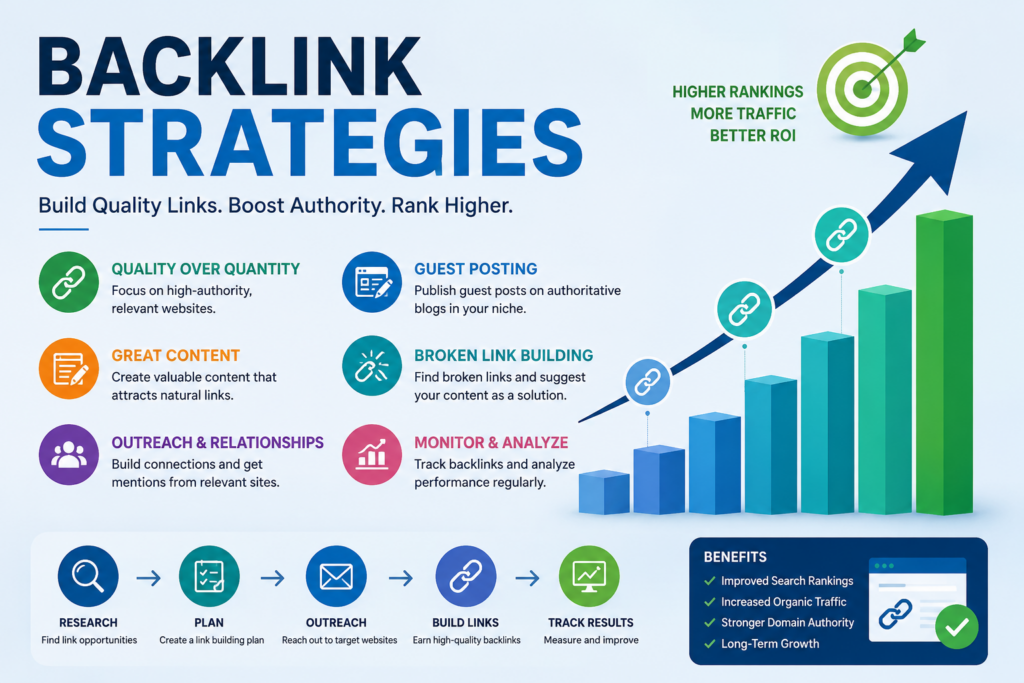
If you want your website to rank higher on Google, creating great content is only part of the process. You also need other websites to trust your content and link to it. That is where backlink strategies become important.
A backlink is simply a link from one website to another. When a trusted website links to your content, search engines see it as a sign that your page offers value. As a result, your website can gain more authority, improve its rankings, and attract more organic visitors.
However, not every backlink helps your SEO. Some links improve your rankings, while others can hurt your website if they come from low-quality or spammy sources. Therefore, using the right backlink strategies is more important than building a large number of links.
In this guide, you will learn how backlinks work, why they matter, and which strategies still work in 2026. You will also find practical examples, real-world tips, and common mistakes to avoid so you can build a strong backlink profile with confidence.
Whether you are a beginner, a blogger, a business owner, or an SEO professional, this guide will help you create a backlink strategy that delivers long-term results.
What Are Backlink Strategies?
Backlink strategies are planned methods used to earn links from other websites. These links point visitors and search engines to your content, helping improve your website’s visibility and credibility.
Think of backlinks as recommendations.
Imagine two local restaurants. One restaurant is recommended by popular food bloggers, travel websites, and local newspapers. The other has no recommendations at all. Most people are more likely to trust the restaurant that others recommend.
Google works in a similar way.
When reputable websites link to your content, Google considers your page more trustworthy. Consequently, your chances of appearing higher in search results increase.
However, successful backlink building is not about collecting as many links as possible. Instead, it focuses on earning links from relevant and authoritative websites.
Example
Suppose you publish an article titled:
“Complete Keyword Research Guide for Beginners.”
If respected SEO blogs, marketing agencies, or educational websites reference your guide, Google receives strong signals that your content is useful.
On the other hand, buying hundreds of unrelated backlinks from spam websites provides little value and may even lead to ranking losses.
How Backlinks Work?
Every backlink passes a certain level of authority from one website to another. This process is often called link equity or link value.
Google evaluates several factors before deciding how valuable a backlink is.
These include:
- The authority of the linking website
- The relevance of the linking page
- The quality of the content
- The placement of the link
- The anchor text used
- Whether the link is natural
For example, a backlink from a respected digital marketing blog is far more valuable than dozens of links from unrelated directories.
Types of Backlinks
Understanding different backlink types helps you choose the right strategy.
Editorial Backlinks
Editorial backlinks are naturally placed by another website because they find your content useful.
These are the most valuable backlinks because they are earned rather than requested.
Example
A marketing blog links to your article while explaining SEO best practices.
Guest Post Backlinks
Guest posting means writing an article for another website and including a relevant link to your own content.
When done on reputable websites, guest posting remains one of the safest backlink strategies.
Resource Page Links
Many websites maintain pages that list useful tools, guides, and educational resources.
If your content genuinely helps readers, website owners may include your article on these pages.
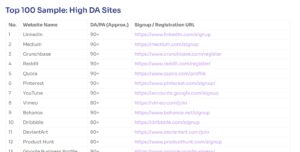
Business Directory Links
Submitting your business to trusted directories can improve local SEO.
Examples include:
- Google Business Profile
- Bing Places
- Industry-specific directories
- Local business associations
Avoid low-quality directory submissions that exist only for link building.
Social Profile Links
Although most social media links do not directly pass SEO authority, they increase content visibility and may help you earn natural backlinks from people who discover your content.
Forum and Community Links
Participating in communities like Reddit, Quora, or niche forums can drive referral traffic.
However, only share links when they genuinely answer a question. Avoid excessive self-promotion.
Why Are Backlink Strategies Important for SEO?
Backlinks remain one of Google’s strongest ranking signals.
While Google’s algorithm now considers hundreds of ranking factors, quality backlinks continue to play a major role in determining which pages deserve higher visibility.
Here are the main reasons why backlink strategies matter.
1. Improve Search Rankings
When authoritative websites link to your content, search engines see your pages as trustworthy.
As a result, your rankings for competitive keywords can improve over time.
Example
Website A publishes excellent content but has very few backlinks.
Website B publishes similar content but receives backlinks from respected industry blogs.
In many cases, Website B will rank higher because Google sees stronger authority signals.
2. Increase Domain Authority
Although Domain Authority (DA) is not a Google ranking factor, it is a useful indicator of your website’s overall strength.
High-quality backlinks often lead to:
- Better keyword rankings
- Faster indexing
- Greater trust from users
- Increased visibility
3. Drive Referral Traffic
Backlinks do more than improve SEO. They also send real visitors to your website.
For example, if a popular technology blog recommends your SEO guide, readers may click the link to learn more. These visitors are often highly interested in your content, products, or services.
4. Build Brand Authority
When trusted websites regularly mention your brand, people begin to recognize you as an expert.
Over time, this increases:
- Brand awareness
- Customer trust
- Industry credibility
- Media opportunities
5. Help Search Engines Discover New Pages
Search engine bots follow links to discover new content.
If your new article receives backlinks shortly after publication, search engines may find and index it more quickly.
How Google Evaluates Backlinks?
Not all backlinks provide the same value. Google analyzes several signals before deciding how much authority a backlink should pass.
Website Authority
Links from respected, trustworthy websites usually carry more weight.
For example:
- Government websites
- Educational institutions
- Established news websites
- Well-known industry blogs
These websites have earned credibility over many years.
Relevance
Google prefers backlinks from websites that cover similar topics.
Example
Imagine you own a digital marketing website.
A backlink from an SEO blog is highly relevant.
A backlink from an unrelated pet care website is much less valuable, even if that website has good authority.
Content Quality
Google evaluates the quality of the page containing the backlink.
Pages with:
- Original research
- Helpful guides
- Expert insights
- Updated information
typically pass more value than thin or duplicate pages.
Anchor Text
Anchor text is the clickable text used in a hyperlink.
Good examples include:
- Learn more about backlink strategies
- Complete SEO checklist
- Keyword research guide
Avoid using the exact same keyword repeatedly across many backlinks. A natural mix of branded, generic, and descriptive anchor text looks more authentic.
Link Placement
Backlinks placed naturally within the main content usually carry more value than links hidden in footers, sidebars, or unrelated sections.
For example, a backlink included in the middle of a helpful article is generally stronger than one placed in a site-wide footer.
Natural Link Profile
Google rewards websites that earn backlinks naturally over time.
A healthy backlink profile includes links from different types of websites, such as blogs, news sites, industry publications, business directories, and educational resources. Diversity makes your backlink profile appear more authentic and resilient.
Key Takeaways
Before you begin building backlinks, remember these essential principles:
- Focus on quality instead of quantity.
- Earn links from websites related to your niche.
- Create valuable content that others want to reference.
- Avoid spammy or paid links that violate Google’s guidelines.
- Build backlinks gradually for long-term SEO success.
- Use a mix of backlink types to maintain a natural profile.
By following these principles, you lay a strong foundation for sustainable organic growth.
15 Proven Backlink Strategies to Build High-Quality Links
Now that you understand how backlinks work and why they matter, it’s time to learn the backlink strategies that consistently deliver results.
These are white-hat techniques that follow Google’s guidelines and help you earn links naturally. While they require time and effort, they build long-term authority and reduce the risk of penalties.
1. Create Link-Worthy Content
The best backlink strategies always start with exceptional content. People link to content that solves problems, answers questions, or presents unique information.
Instead of writing short articles that repeat existing information, focus on creating resources people want to reference.
Examples include:
- Complete guides
- Original research
- Industry statistics
- Step-by-step tutorials
- Free templates
- Checklists
- Case studies
- Infographics
Example
Instead of publishing:
“What Is SEO?”
Create:
The Complete SEO Guide for Beginners: Step-by-Step with Examples
A comprehensive guide is much more likely to attract backlinks because it becomes a valuable reference.
Tips
- Cover the topic in depth.
- Use simple language.
- Add screenshots and visuals.
- Keep information updated.
- Include real examples.
The more helpful your content is, the easier it becomes to earn natural backlinks.
2. Write High-Quality Guest Posts
Guest posting remains one of the most reliable backlink strategies when done correctly.
The goal is not to publish articles everywhere. Instead, contribute valuable content to reputable websites in your industry.
Good Guest Posting Process
- Find websites related to your niche.
- Read their existing content.
- Pitch a unique topic.
- Write original content.
- Include one or two relevant backlinks naturally.
Example
Suppose you own a digital marketing website.
You could contribute an article titled:
“10 Local SEO Mistakes Small Businesses Should Avoid”
Within the article, you may naturally link to your detailed Local SEO guide.
Readers benefit from additional information, and you gain a high-quality backlink.
Avoid These Mistakes
- Publishing on spam websites
- Using duplicate content
- Stuffing keywords
- Buying guest posts in bulk
- Adding unrelated links
Google rewards quality, not quantity.
3. Use Broken Link Building
Broken link building is one of the smartest backlink strategies because it helps both you and the website owner.
Sometimes websites link to pages that no longer exist.
These broken links create a poor user experience.
You can identify these broken links and suggest your own relevant content as a replacement.
How It Works
- Find broken links on industry websites.
- Create similar or better content.
- Contact the website owner.
- Recommend replacing the broken link with your page.
Example
Imagine a marketing blog links to an SEO statistics page that returns a 404 error.
If your website has an updated SEO statistics article, you can politely suggest it as a replacement.
Everyone benefits:
- The website fixes a broken link.
- Readers receive updated information.
- You earn a valuable backlink.
4. Build Resource Page Links
Many websites maintain dedicated resource pages.
These pages recommend useful articles, tools, and guides.
If your content provides genuine value, resource pages can become an excellent source of backlinks.
Example Resource Pages
- SEO Resources
- Digital Marketing Tools
- Business Growth Guides
- Free Learning Resources
- Blogging Tutorials
Outreach Example
Hello [Name],
I noticed your resource page about SEO tools. Recently, we published a comprehensive guide on backlink strategies that your readers may find useful.
If you think it adds value, feel free to include it.
Thank you for your time.
Keep outreach short, polite, and personalized.
5. Publish Original Research and Statistics
Original data naturally attracts backlinks because writers and journalists need reliable sources.
Instead of repeating existing information, collect your own data.
Ideas include:
- Industry surveys
- Customer research
- SEO experiments
- Marketing benchmarks
- Performance reports
Example
Suppose your agency analyzes 500 websites and discovers:
Websites publishing blogs twice a week gained 42% more organic traffic over twelve months.
Many bloggers may cite your research and link back to the original source.
That single report could generate backlinks for years.
6. Use the Skyscraper Technique
The Skyscraper Technique involves improving existing popular content and creating something significantly better.
Step 1
Find content with many backlinks.
Step 2
Improve it by adding:
- Updated information
- Better visuals
- More examples
- Practical tips
- FAQs
- Case studies
Step 3
Reach out to websites already linking to older content.
Explain why your updated guide provides more value.
Example
Existing article:
“20 SEO Tips”
Your version:
“75 Proven SEO Tips for 2026 with Examples, Case Studies, and Free Checklist.”
A more complete resource has a better chance of earning links.
7. Become a Source for Journalists
Journalists regularly look for expert opinions.
When your insights are quoted in articles, they often include backlinks.
You can increase these opportunities by:
- Sharing industry expertise
- Publishing original research
- Responding quickly to media requests
- Building authority on professional networks
Example
A business publication asks:
“How has AI changed SEO?”
You provide an expert answer.
The publication quotes your response and links to your website.
This type of backlink usually comes from highly authoritative domains.
8. Analyze Competitor Backlinks
One of the easiest backlink strategies is learning from competitors.
If several websites already link to competitors, they may also be interested in your content.
Use SEO tools to identify:
- Top linking websites
- Popular content
- Frequently linked pages
- Industry directories
- Guest posting opportunities
Example
Suppose your competitor receives backlinks from:
- Marketing blogs
- Startup websites
- Local business associations
You can create a better article and contact those same websites.
This approach saves time because the websites have already shown interest in similar topics.
Real-World Case Study
How Helpful Content Earned Natural Backlinks
A small digital marketing agency wanted to improve its rankings for keyword research.
Instead of buying backlinks, the team created a detailed guide that included:
- Beginner-friendly explanations
- Free keyword research tools
- Practical examples
- Downloadable checklist
- Frequently asked questions
- Updated screenshots
After publishing the guide, they promoted it through:
- LinkedIn posts
- Email newsletters
- SEO communities
- Industry forums
- Outreach to bloggers
Results After Eight Months
- Organic traffic increased by 118%.
- The guide earned 85+ natural backlinks from marketing blogs and business websites.
- Several keywords reached Google’s first page.
- Time on page improved because visitors found the content useful and easy to follow.
Key Lesson
The agency focused on creating value first. Because the guide solved real problems, other websites linked to it voluntarily. This demonstrates that high-quality content, combined with thoughtful promotion, is one of the most effective backlink strategies for long-term SEO success.
9. Reclaim Lost and Unlinked Brand Mentions
One of the easiest backlink strategies is turning brand mentions into backlinks.
Sometimes websites mention your business, blog, product, or research but forget to add a link. Since they already know your brand, they are often willing to include one when asked politely.
How to Find Brand Mentions
You can use tools such as:
- Google Alerts
- Ahrefs Content Explorer
- Semrush Brand Monitoring
- Mention
Example
A marketing blog writes:
“AdsNSEO published a helpful Keyword Research Guide.”
If the article doesn’t link to your guide, send a friendly email asking whether they can add the link for readers’ convenience.
Because the content already mentions your brand, the success rate is often higher than cold outreach.
10. Create Shareable Infographics
People enjoy visual content because it explains complex topics quickly.
A well-designed infographic can attract backlinks from bloggers, educators, and publishers.
Popular infographic topics include:
- SEO Checklist
- Google Ranking Factors
- Link Building Process
- Content Marketing Workflow
- Technical SEO Audit Steps
Example
Instead of publishing only text about backlink building, create an infographic titled:
“The Complete Backlink Building Process in 10 Steps.”
Many websites may embed your infographic and credit your website with a backlink.
Best Practices
- Keep the design simple.
- Use accurate data.
- Include your logo and website URL.
- Offer an embed code to make sharing easy.
11. Build Relationships Within Your Industry
Successful link building is about relationships, not just emails.
When people know and trust your work, they are more likely to reference your content naturally.
Ways to Build Relationships
- Comment on industry blogs.
- Participate in webinars.
- Join SEO communities.
- Share others’ content.
- Attend conferences.
- Connect on LinkedIn.
Example
Suppose you regularly contribute valuable insights in an SEO community. Over time, bloggers and marketers become familiar with your expertise. When they need a reliable source, they are more likely to link to your articles.
Relationship building creates backlink opportunities that cannot be achieved through automated outreach.
12. Publish Free Tools and Templates
Free resources often attract backlinks because they provide immediate value.
Examples include:
- SEO audit checklist
- Keyword research template
- Website migration checklist
- Content calendar
- Meta title generator
- SEO ROI calculator
Example
Imagine you publish a free “Keyword Difficulty Calculator.”
Marketing blogs, agencies, and educators may recommend it to their audiences, earning you high-quality backlinks over time.
This strategy also increases repeat visitors and strengthens your brand authority.
13. Repurpose Content Into Different Formats
Not everyone prefers reading long blog posts.
Repurposing content into different formats expands your reach and increases the chances of earning backlinks.
You can convert one article into:
- Videos
- Slide presentations
- Podcasts
- Infographics
- Social media posts
- Downloadable PDFs
Example
A 3,000-word guide on backlink strategies can become:
- A YouTube tutorial
- A LinkedIn carousel
- A webinar presentation
- A downloadable checklist
Each format reaches a new audience, creating more opportunities for backlinks.
14. Publish Expert Roundup Articles
Expert roundup articles feature advice from multiple industry professionals.
Because contributors are included, many of them share the article or link to it from their own websites.
Example
Article Title:
“25 SEO Experts Share Their Best Backlink Strategy for 2026”
Each expert contributes one practical tip.
The article becomes highly valuable because readers receive multiple perspectives in one place.
Additionally, contributors often promote the article, increasing both traffic and backlinks.
15. Promote Your Content Consistently
Publishing content is only the beginning.
Without promotion, even excellent articles may receive very few backlinks.
Promote every new article through multiple channels.
Content Promotion Checklist
- Share on LinkedIn
- Publish on Facebook
- Post on X (Twitter)
- Send an email newsletter
- Participate in relevant communities
- Contact industry bloggers
- Reach out to resource page owners
- Share in professional groups
The more visibility your content receives, the greater the chance that someone will reference it.
Common Backlink Building Mistakes to Avoid
Many websites lose rankings because they focus on shortcuts instead of sustainable SEO.
Avoid these common mistakes.
Buying Backlinks
Purchasing backlinks violates Google’s guidelines.
While paid links may produce short-term gains, they can lead to manual actions or ranking drops.
Instead, invest in creating valuable content that earns links naturally.
Focusing Only on Quantity
Receiving 500 low-quality backlinks is not as beneficial as earning 10 links from respected industry websites.
Always prioritize relevance, authority, and trust over volume.
Ignoring Relevance
A backlink from a website closely related to your niche carries far more value than one from an unrelated source.
For example, a digital marketing website benefits more from links on SEO, business, or technology sites than from links on unrelated topics.
Using the Same Anchor Text Repeatedly
If every backlink uses the exact phrase “backlink strategies,” it may appear manipulative.
Instead, use a natural mix of anchor texts, such as:
- Backlink strategies
- Link building guide
- Learn more
- Visit our blog
- Brand name
- This SEO resource
A diverse anchor text profile looks more natural to search engines.
Neglecting Existing Content
Many website owners focus only on publishing new articles.
However, updating existing content with fresh statistics, screenshots, and examples can help attract new backlinks without creating additional pages.
Best Tools for Backlink Analysis
The right tools help you monitor your backlink profile, discover opportunities, and analyze competitors.
| Tool | Best For |
| Google Search Console | Viewing backlinks recognized by Google |
| Ahrefs | Comprehensive backlink analysis and competitor research |
| Semrush | Link building campaigns and backlink audits |
| Moz Pro | Domain Authority and backlink monitoring |
| Majestic | Trust Flow and Citation Flow analysis |
| Screaming Frog SEO Spider | Finding broken internal and external links |
What to Monitor
- New backlinks
- Lost backlinks
- Referring domains
- Anchor text distribution
- Toxic backlinks
- Domain authority of linking sites
Regular monitoring helps you maintain a healthy backlink profile.
Case Study: Quality Over Quantity
A small software company wanted to improve its rankings for competitive keywords.
Initially, the company purchased hundreds of inexpensive backlinks from unrelated websites.
Results
Within a few months:
- Organic traffic declined.
- Several keywords dropped in rankings.
- Many backlinks came from low-quality domains.
The team changed its strategy and focused on:
- Publishing comprehensive guides.
- Writing guest posts for reputable industry websites.
- Creating original research.
- Conducting personalized outreach.
- Updating existing content.
Results After 12 Months
- Organic traffic increased by 165%.
- Referring domains doubled.
- Several target keywords ranked on Google’s first page.
- Lead generation improved because visitors trusted the website more.
Lesson
A few high-quality backlinks from trusted websites can have a greater impact than hundreds of low-quality links. Sustainable backlink strategies consistently outperform shortcuts in the long run.
Measuring the Success of Your Backlink Strategy
Building backlinks is only one part of SEO. You should also measure whether your efforts are delivering results.
Track these key metrics:
- Number of referring domains
- Growth in organic traffic
- Keyword rankings
- Click-through rate (CTR)
- Domain Authority (DA) or Domain Rating (DR)
- Referral traffic
- Conversion rate from referral visitors
Review these metrics monthly to understand which backlink strategies are driving the best results and where you can improve.
Advanced Backlink Strategies for Long-Term SEO Success
Building backlinks is not a one-time task. Google’s algorithms continue to evolve, and websites that focus on quality, trust, and user value consistently achieve better results.
Below are advanced backlink strategies that can help you stay ahead of your competitors.
1. Prioritize Topical Authority
Google prefers websites that demonstrate expertise in a specific subject rather than covering unrelated topics.
For example, if your website focuses on digital marketing, publish multiple in-depth articles on topics such as:
- Keyword Research
- On-Page SEO
- Technical SEO
- Local SEO
- Link Building
- Content Marketing
- Google Search Console
- AI SEO
- SEO Audits
When these articles link to one another, they create a strong content cluster. As your topical authority grows, other websites are more likely to reference your content, leading to more natural backlinks.
2. Keep Your Content Updated
Search engines and readers both value fresh, accurate information.
Review your top-performing articles every few months and update them by:
- Adding new statistics
- Replacing outdated screenshots
- Improving examples
- Expanding FAQs
- Including the latest SEO trends
Updated content often regains rankings and attracts new backlinks because it remains a reliable resource.
3. Strengthen Internal Linking
Although internal links are not backlinks, they help distribute authority across your website.
For example, this article should naturally link to related resources such as:
- Keyword Research Guide
- On-Page SEO Guide
- Technical SEO Guide
- Content Marketing Guide
- Local SEO Guide
A strong internal linking structure helps both users and search engines discover related content more easily.
4. Build a Recognizable Brand
People are more likely to link to brands they know and trust.
Increase your brand visibility by:
- Publishing original research
- Speaking at webinars
- Sharing useful content on LinkedIn
- Answering questions in SEO communities
- Writing guest articles
- Creating free SEO resources
As your reputation grows, backlinks often come naturally without extensive outreach.
Backlink Strategies Checklist
Use this checklist to ensure you’re following best practices.
1.Create helpful, original content.
- Publish comprehensive guides.
- Build relationships with industry experts.
- Write guest posts on reputable websites.
- Find and replace broken links.
- Earn links from resource pages.
- Monitor your backlink profile regularly.
- Remove or disavow harmful backlinks when necessary.
- Update older articles.
- Focus on quality rather than quantity.
Frequently Asked Questions
1.What are backlink strategies?
Backlink strategies are methods used to earn links from other websites. These links improve your website’s authority, increase organic traffic, and help your pages rank higher in search results.
2. Why are backlinks important for SEO?
Backlinks act as trust signals for search engines. When reputable websites link to your content, Google sees your website as more credible, which can improve rankings and visibility.
3. How many backlinks do I need to rank?
There is no fixed number. A website with 20 high-quality backlinks from trusted and relevant sources may outperform another website with 500 low-quality backlinks. Quality always matters more than quantity.
4.Are paid backlinks safe?
No.
Buying backlinks that pass ranking value violates Google’s Search Essentials and can result in ranking losses or manual actions. Instead, focus on earning backlinks naturally through valuable content and ethical outreach.
5.Which backlink strategy works best?
The most effective backlink strategies include:
- Creating high-quality content
- Guest blogging
- Publishing original research
- Broken link building
- Resource page outreach
- Competitor backlink analysis
- Digital PR
Combining several strategies usually produces the best long-term results.
6.How long does backlink building take?
Backlink building is a long-term process.
Many websites begin seeing improvements within three to six months, while competitive industries may require more time.
Consistency is the key to sustainable growth.
7.Can backlinks improve local SEO?
Yes.
Local businesses benefit from backlinks from:
- Local newspapers
- Community organizations
- Industry associations
- Business directories
- Local blogs
These links help strengthen local search visibility.
8.Which tools are best for backlink analysis?
Popular backlink analysis tools include:
- Google Search Console
- Ahrefs
- Semrush
- Moz Pro
- Majestic
These tools help you monitor backlinks, discover new opportunities, and identify potentially harmful links.
Final Thoughts
Effective backlink strategies are built on trust, relevance, and value. While shortcuts may seem appealing, they rarely produce lasting results. Instead, focus on creating content that genuinely helps your audience, build relationships within your industry, and earn links from reputable websites.
Remember that every quality backlink is a signal of confidence in your content. As your library of useful articles grows, your website can gain authority, improve keyword rankings, and attract more qualified visitors. Consistency and patience are essential because strong backlink profiles develop over time, not overnight.
Whether you are starting a new website or improving an established one, the principles remain the same: publish exceptional content, promote it thoughtfully, and measure your results regularly. Following these practices will help you build a backlink profile that supports sustainable SEO success.
Conclusion
High-quality backlinks continue to be one of the strongest ranking signals in modern SEO. However, success comes from earning links naturally rather than trying to manipulate search engines.
By applying the 15 backlink strategies covered in this guide, you can:
- Improve your website’s authority.
- Increase organic traffic.
- Build trust with users and search engines.
- Strengthen your search rankings over time.
- Create a sustainable SEO strategy that delivers long-term results.
Start with one or two strategies, measure your progress, and refine your approach as your website grows. Small, consistent improvements often lead to significant gains over time.
Ready to strengthen your website’s SEO with effective backlink strategies?
Explore our related resources to deepen your knowledge:
- Keyword Research Guide
- On-Page SEO Guide
- Technical SEO Guide
- Content Marketing Guide
- SEO Audit Checklist
If you need expert assistance with ethical link building, content marketing, or a complete SEO strategy, AdsNSEO can help you build a stronger online presence and achieve sustainable organic growth.