
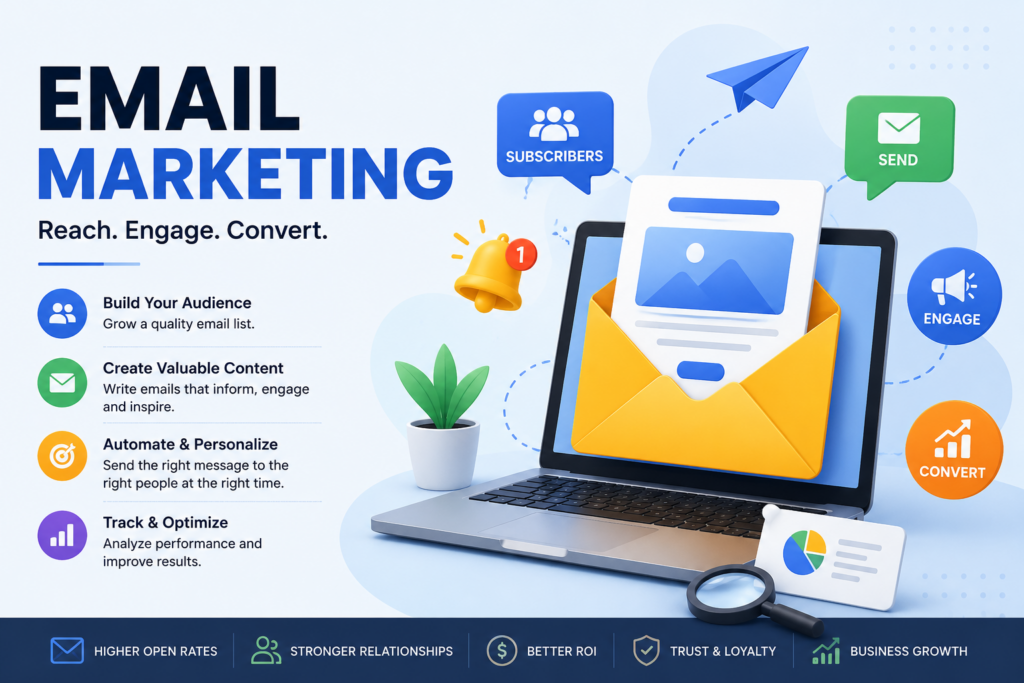
Email marketing remains one of the most effective ways to reach customers, build trust, and increase sales. Although new social media platforms appear every year, email continues to deliver one of the highest returns on investment (ROI) for businesses of all sizes. Unlike social media, where algorithms control who sees your content, email gives you direct access to your audience.
Whether you own a small business, run an online store, manage a startup, or work as a digital marketer, this Email Marketing Guide will help you understand everything from the basics to advanced strategies. You will also learn how to build an email list, write engaging emails, automate campaigns, and measure success.
By the end of this guide, you will have a clear roadmap to create email campaigns that attract readers, encourage action, and build lasting customer relationships.
What Is Email Marketing?
Email marketing is a digital marketing strategy that uses email to communicate with customers and potential customers. Businesses send emails to share useful information, promote products or services, announce updates, nurture leads, and build long-term relationships.
Instead of sending the same message to everyone, modern email marketing allows businesses to personalize emails based on customer interests, behavior, and purchase history. As a result, recipients receive more relevant content, which increases engagement and conversions.
For example, imagine an online clothing store.
A visitor signs up to receive a 10% discount. After signing up, the customer receives:
- A welcome email
- Product recommendations
- Seasonal offers
- Order confirmation emails
- Shipping updates
- Customer feedback requests
Each email serves a different purpose, yet together they create a better customer experience.
How Email Marketing Works?
Email marketing follows a simple process.
- A visitor subscribes to your email list.
- The subscriber gives permission to receive emails.
- The business stores the email securely.
- The business sends valuable and relevant emails.
- The subscriber opens the email and clicks a link.
- Finally, the subscriber completes a desired action, such as making a purchase or filling out a form.
This process may seem simple. However, successful email marketing requires planning, testing, and continuous improvement.
Why Is Email Marketing Important?
Many people believe social media has replaced email. However, email remains one of the strongest marketing channels because it gives businesses direct communication with their audience.
Unlike social platforms, you own your email list. Therefore, changes in social media algorithms do not affect your ability to reach subscribers.
Moreover, people usually check their email several times each day. This habit creates more opportunities for businesses to connect with customers at the right time.
Key Reasons Email Marketing Matters
Direct Communication
Emails arrive directly in a subscriber’s inbox. Consequently, businesses can communicate without depending on third-party platforms.
Higher Return on Investment
Email marketing often delivers a higher return than many other digital marketing channels because sending emails costs relatively little compared to paid advertising.
Better Customer Relationships
Useful emails build trust over time. Instead of constantly selling, businesses can educate customers, answer questions, and provide valuable resources.
Increased Website Traffic
Every email can encourage readers to visit your website, read blog posts, explore new products, or complete purchases.
Improved Customer Retention
Keeping existing customers is usually easier than acquiring new ones. Therefore, regular email communication helps customers stay connected with your brand.
Benefits of Email Marketing
Businesses across different industries use email marketing because it offers many advantages.
1. Cost-Effective Marketing
Email marketing requires a smaller budget than many traditional advertising methods.
For example, instead of spending thousands on television or newspaper advertisements, businesses can send professional email campaigns at a much lower cost.
This makes email marketing ideal for startups, small businesses, and growing companies.
2. Builds Customer Trust
Trust develops through consistent communication.
Rather than sending promotional emails every day, successful businesses share:
- Helpful guides
- Industry news
- Educational content
- Tips and tricks
- Product updates
As a result, subscribers begin to view the brand as a reliable source of information.
3. Reaches the Right Audience
Modern email marketing platforms allow businesses to send different emails to different groups of subscribers.
For example:
- New subscribers receive welcome emails.
- Existing customers receive loyalty offers.
- Inactive subscribers receive re-engagement emails.
Therefore, each person receives content that matches their interests.
4. Supports Every Stage of the Customer Journey
Customers rarely purchase immediately.
Instead, they move through several stages.
Awareness
Customers first discover your business.
Consideration
Next, they compare products, services, and competitors.
Decision
Finally, they decide whether to purchase.
Email marketing supports each stage by providing useful information that helps customers make informed decisions.
5. Easy to Measure
Unlike many traditional marketing methods, email marketing provides detailed reports.
Businesses can measure:
- Open rate
- Click-through rate (CTR)
- Conversion rate
- Bounce rate
- Unsubscribe rate
These insights help marketers improve future campaigns.
6. Encourages Repeat Purchases
Customers who have already purchased are often more likely to buy again.
For example, an online electronics store might send:
- Product care tips
- Accessory recommendations
- Warranty reminders
- Upgrade offers
Consequently, customers stay engaged and continue buying from the business.
7. Increases Brand Awareness
Even when subscribers do not make an immediate purchase, regular emails keep your business in their minds.
Over time, consistent communication builds brand recognition and familiarity.
Types of Email Marketing
Not every email has the same purpose. Understanding different email types helps businesses create more effective campaigns.
1. Welcome Emails
Welcome emails are the first emails subscribers receive after joining your email list.
They usually include:
- A warm greeting
- Brand introduction
- Discount coupon
- Helpful resources
- Next steps
Example
A fitness company sends:
Welcome! Here’s your free beginner workout guide and a 15% discount on your first membership.
Welcome emails often receive higher engagement because subscribers expect them.
2. Newsletter Emails
Newsletters keep subscribers informed.
They may include:
- Blog articles
- Company updates
- Industry news
- Helpful tips
- Upcoming events
For example, a digital marketing agency can send a monthly newsletter featuring SEO updates, social media trends, and content marketing tips.
3. Promotional Emails
Promotional emails encourage subscribers to take action.
Common examples include:
- Seasonal sales
- Holiday discounts
- Product launches
- Limited-time offers
- Special coupons
Because these emails focus on conversions, they should include a clear call to action (CTA).
Example CTA:
- Shop Now
- Get Your Discount
- Start Free Trial
- Download Now
4. Transactional Emails
Transactional emails are automatically triggered after a customer performs an action.
Examples include:
- Order confirmations
- Payment receipts
- Shipping updates
- Password reset emails
- Account verification
Although these emails are automated, they still contribute to a positive customer experience.
5. Abandoned Cart Emails
Sometimes customers add products to their shopping cart but leave without completing the purchase.
An abandoned cart email reminds them to return.
Example:
You left two items in your cart. Complete your order today and enjoy free shipping.
These emails often recover lost sales.
6. Re-Engagement Emails
Some subscribers stop opening emails over time.
Instead of removing them immediately, businesses send re-engagement emails.
These emails might include:
- Special discounts
- New product announcements
- Surveys
- Exclusive content
If subscribers remain inactive, removing them can improve overall email performance.
7. Feedback and Survey Emails
Customer feedback helps businesses improve products and services.
After a purchase, companies often send a short survey asking about the customer’s experience.
For example:
Thank you for your purchase. Please share your feedback in just two minutes.
Positive reviews also help build trust with future customers.
Real-World Example
Imagine a small online bakery that sells custom cakes.
Instead of relying only on social media, the bakery creates an email list.
Here’s how it uses email marketing:
- A visitor downloads a free cake design guide.
- The visitor receives a welcome email.
- Every Friday, the bakery sends decorating tips.
- Before holidays, subscribers receive special offers.
- After each purchase, customers receive thank-you emails and review requests.
- Customers who have not ordered for three months receive a personalized discount.
As a result, the bakery builds stronger customer relationships, encourages repeat orders, and increases revenue without relying solely on paid advertising.
Why Your Email List Is Your Most Valuable Asset?
Your email list is more than a collection of email addresses. It is a community of people who have shown interest in your business.
Unlike followers on social media, your email list belongs to you. Therefore, you are not affected by changing algorithms or reduced organic reach.
A healthy email list helps you:
- Build long-term customer relationships
- Increase website traffic
- Generate repeat sales
- Promote new products and services
- Share valuable educational content
- Improve customer loyalty
The quality of your list is always more important than its size.
How to Build an Email List the Right Way?
Growing an email list takes time. However, using ethical methods helps you attract subscribers who are more likely to become customers.
Create Valuable Content
People usually share their email addresses only when they receive something valuable in return.
Helpful content builds trust and encourages sign-ups.
Examples include:
- Blog articles
- Step-by-step guides
- Free templates
- Checklists
- Video tutorials
- Industry reports
For example, a digital marketing agency could offer a free SEO checklist. Visitors download the guide after entering their email address.
This approach benefits both the visitor and the business.
Offer a Lead Magnet
A lead magnet is a free resource that solves a specific problem.
It gives visitors a strong reason to subscribe.
Popular Lead Magnet Ideas
- eBooks
- Checklists
- Free consultations
- Discount coupons
- Templates
- Case studies
- Webinars
- Free tools
- Email courses
Example
A fitness trainer offers:
“Download a Free 7-Day Weight Loss Meal Plan.”
A software company offers:
“Get Our Free Project Management Template.”
A digital marketing agency offers:
“Free Website SEO Audit Checklist.”
The more useful the lead magnet, the more subscribers you can attract.
Create High-Converting Sign-Up Forms
Your sign-up form should be simple.
Asking for too much information may reduce conversions.
Most businesses only ask for:
- First name
- Email address
You can collect more information later.
Best Places to Add Sign-Up Forms
- Homepage
- Blog posts
- Sidebar
- Footer
- Landing pages
- Contact page
- Checkout page
- Exit-intent popups
However, avoid showing too many popups because they may frustrate visitors.
Write a Strong Call to Action (CTA)
Your CTA tells visitors what they should do next.
Instead of writing:
Submit
Try writing:
- Download Your Free Guide
- Join Our Newsletter
- Get Free SEO Tips
- Start Learning Today
- Claim Your Discount
- Subscribe for Weekly Updates
Clear CTAs often improve conversion rates.
Create Dedicated Landing Pages
A landing page focuses on one goal.
Unlike a homepage, it removes unnecessary distractions.
A landing page should include:
- A clear headline
- Benefits of subscribing
- Images or screenshots
- Testimonials
- A simple sign-up form
- A strong CTA
Example Structure
Headline
Improve Your Website Traffic with Free Weekly SEO Tips
Benefits
- Learn proven SEO strategies
- Receive practical marketing advice
- Stay updated with Google changes
CTA
Subscribe Now
Simple pages usually convert better than cluttered ones.
Never Buy an Email List
Buying email lists may seem like an easy shortcut.
Unfortunately, it creates several problems.
Purchased contacts:
- Did not give permission
- Rarely engage with emails
- Often mark emails as spam
- Increase bounce rates
- Damage sender reputation
Instead, grow your list naturally.
Although it takes longer, the results are far better.
Follow Permission-Based Email Marketing
Always get permission before sending marketing emails.
This practice is called permission-based marketing.
Benefits include:
- Higher trust
- Better engagement
- Lower spam complaints
- Improved deliverability
- Stronger customer relationships
When subscribers choose to join your list, they are much more likely to read your emails.
Segment Your Email List
Not every subscriber has the same interests.
Therefore, sending identical emails to everyone is rarely effective.
Segmentation allows you to divide subscribers into smaller groups.
You can segment based on:
Demographics
- Age
- Gender
- Location
- Language
Customer Behavior
- Pages visited
- Products viewed
- Purchase history
- Download activity
Engagement Level
- Active subscribers
- Inactive subscribers
- New subscribers
- Loyal customers
Interests
Someone interested in SEO may not want emails about social media advertising.
Likewise, an e-commerce customer may prefer product recommendations over technical updates.
Sending relevant emails increases engagement.
Choose the Right Email Marketing Platform
An email marketing platform helps you:
- Store subscribers
- Design emails
- Automate campaigns
- Track performance
- Manage lists
When choosing a platform, consider these features.
Easy Email Builder
Look for drag-and-drop editors that require little or no coding.
Automation
Automation saves time by sending emails automatically.
Examples include:
- Welcome emails
- Birthday emails
- Order confirmations
- Abandoned cart reminders
Templates
Professional templates help you create attractive emails quickly.
Choose templates that work well on mobile devices.
Analytics
Your platform should provide reports such as:
- Open rates
- Click rates
- Bounce rates
- Unsubscribes
- Conversions
These reports help you improve future campaigns.
Integrations
Good platforms integrate with:
- CRM software
- E-commerce platforms
- Website builders
- Customer support tools
- Analytics platforms
Integration reduces manual work.
How to Create Your First Email Campaign?
Creating your first campaign is easier than many beginners expect.
Follow these steps.
Step 1: Define Your Goal
Before writing your email, decide what you want readers to do.
Examples include:
- Read a blog
- Buy a product
- Register for a webinar
- Download an eBook
- Book a consultation
Every email should have one primary objective.
Step 2: Know Your Audience
Think about your readers.
Ask yourself:
- What problem do they have?
- What solution can I offer?
- Why should they open my email?
Understanding your audience improves every campaign.
Step 3: Write an Attention-Grabbing Subject Line
The subject line determines whether people open your email.
Keep it:
- Short
- Clear
- Relevant
- Honest
Good Examples
- 7 Easy SEO Tips for Beginners
- Your Free Website Audit Is Ready
- Save 25% This Weekend Only
- Welcome to Our Community
Poor Examples
- Open This Immediately!!!
- Make Millions Overnight
- Click Here Now!!!
Misleading subject lines reduce trust.
Write a Friendly Preview Text
Preview text appears beside the subject line in many inboxes.
It should encourage readers to open the email.
Example:
Subject
Improve Your SEO Today
Preview Text
Discover five simple techniques you can implement this week.
This small detail can improve open rates.
Write a Personalized Greeting
Personalization makes emails feel more human.
Instead of:
Hello Customer,
Try:
Hello Sarah,
or
Hi John,
If you do not know the subscriber’s name, use:
Hello there,
or
Hi friend,
Natural greetings help build stronger relationships.
Focus on One Main Message
Many businesses try to include too much information in one email.
However, shorter emails often perform better.
For example, if your goal is to promote a webinar, avoid discussing unrelated products or company updates.
A single message keeps readers focused.
Real-World Example
Imagine you own an online gardening store.
A visitor downloads your free guide:
“10 Easy Vegetables You Can Grow at Home.”
Immediately after signing up, they receive:
- A welcome email
- Beginner gardening tips
- Weekly seasonal advice
- Product recommendations based on their interests
- Exclusive subscriber discounts
Over the next few months, the visitor becomes a loyal customer because each email provides useful information rather than constant sales pitches.
This example shows how valuable content builds trust before asking for a sale.
Know Your Audience Before You Write
Successful email marketing begins with understanding your audience.
Before writing any email, ask yourself:
- Who is this email for?
- What problem are they trying to solve?
- What information do they need today?
- What action do I want them to take?
When your content answers these questions, subscribers are more likely to stay engaged.
Example
Imagine you own a digital marketing agency.
A small business owner may want to learn how to attract more website visitors.
Instead of promoting your services immediately, you could share three practical SEO tips. At the end of the email, invite readers to request a free website audit.
This approach builds trust before making a sales offer.
Write Subject Lines That Increase Open Rates
The subject line is the first thing subscribers notice.
If it does not capture attention, your email may never be opened.
Tips for Better Subject Lines
- Keep it between 40 and 60 characters.
- Clearly explain the value.
- Create curiosity without being misleading.
- Use action words.
- Avoid excessive punctuation or capital letters.
- Personalize when appropriate.
Good Examples
- Improve Your Website Traffic in 30 Days
- Your Free SEO Checklist Is Ready
- Five Email Marketing Tips You Can Use Today
- Welcome! Here’s Your Free Guide
- Save 20% Before Sunday
Poor Examples
- CLICK THIS NOW!!!
- You Won’t Believe This!!!
- Make Money Instantly!!!
- Urgent!!!!!
Misleading subject lines may increase spam complaints and reduce trust.
Use Preview Text Effectively
Preview text appears next to the subject line in many email apps.
Think of it as a second headline.
Example
Subject
Improve Your Email Open Rates
Preview Text
Learn five proven techniques that help businesses increase engagement.
Together, the subject line and preview text encourage subscribers to open your email.
Start with a Friendly Introduction
The opening paragraph should quickly explain why the email matters.
Avoid long introductions.
Instead, get to the point.
Example
Hi Sarah,
Thank you for joining our community.
Today, we’re sharing five simple email marketing tips that can help you increase customer engagement without spending more on advertising.
This introduction feels natural and immediately delivers value.
Focus on One Goal
Many businesses include multiple offers in one email.
As a result, readers become confused.
Instead, give each email one primary objective.
For example:
- Download a guide
- Read a blog post
- Register for a webinar
- Purchase a product
- Schedule a consultation
When readers know exactly what to do, conversions usually improve.
Keep Your Email Simple
Simple emails often perform better than complex designs.
Follow these best practices:
- Write short paragraphs.
- Use clear headings.
- Add bullet points where needed.
- Leave enough white space.
- Highlight important information.
- Use a readable font size.
Your goal is to make the email easy to scan.
Write Like You’re Having a Conversation
Avoid complicated words and technical jargon whenever possible.
Instead, write as if you are speaking to one person.
Instead of:
“Our organization has implemented an advanced customer engagement methodology.”
Write:
“We’ve found a simple way to help customers stay engaged.”
Plain language improves readability and keeps readers interested.
Provide Value Before Selling
Subscribers join your list because they expect useful content.
Therefore, every email should teach, solve, or inspire.
Helpful content may include:
- Practical tips
- Industry news
- Step-by-step tutorials
- Case studies
- Checklists
- Free resources
Once readers trust your expertise, they are more likely to buy from you.
Use Strong Calls to Action (CTAs)
Every marketing email should tell readers what to do next.
A clear CTA removes confusion.
Effective CTA Examples
- Read the Full Guide
- Download Your Free Template
- Start Your Free Trial
- Book a Free Consultation
- Shop the Collection
- Learn More
- Register Today
CTA Best Practices
- Use action-oriented words.
- Make the button easy to find.
- Keep the text short.
- Focus on one CTA per email.
Too many buttons may reduce clicks.
Design Mobile-Friendly Emails
More than half of marketing emails are opened on smartphones.
Therefore, mobile optimization is essential.
Best Practices
- Use responsive email templates.
- Keep subject lines short.
- Write concise paragraphs.
- Make buttons large enough to tap.
- Use readable fonts.
- Compress images to improve loading speed.
Always test your email on both desktop and mobile devices before sending it.
Use Images Carefully
Images make emails more attractive.
However, too many images can slow loading times and distract readers.
Include Images That:
- Support your message
- Showcase products
- Explain a process
- Highlight offers
Avoid using images that contain all your important text because some email clients block images by default.
Always add descriptive alt text so readers understand the image if it doesn’t load.
Personalize Your Emails
Personalization goes beyond adding a subscriber’s name.
Modern email platforms allow businesses to send highly relevant content.
You Can Personalize Based On:
- First name
- Location
- Previous purchases
- Browsing history
- Interests
- Customer lifecycle stage
Example
Instead of sending the same email to everyone:
A gardening store sends indoor plant tips to indoor gardening enthusiasts and vegetable-growing advice to subscribers interested in home farming.
Relevant emails receive more engagement.
Understand Email Marketing Automation
Automation sends emails automatically after specific actions.
This saves time while creating a better customer experience.
Common Automation Triggers
- New subscription
- Product purchase
- Cart abandonment
- Birthday
- Downloading a resource
- Visiting a pricing page
- Inactive subscribers
Automation allows businesses to communicate consistently without manually sending every email.
Create an Effective Welcome Email Sequence
A welcome sequence introduces new subscribers to your business.
Instead of sending only one email, create a series.
Example Welcome Sequence
Email 1
Welcome the subscriber.
Deliver the promised resource.
Email 2
Introduce your company.
Share your mission and values.
Email 3
Provide useful educational content.
Email 4
Share customer success stories.
Email 5
Offer a discount or free consultation.
This gradual approach builds trust before asking for a purchase.
Use Drip Campaigns to Nurture Leads
A drip campaign is a sequence of emails sent over time.
Each email moves subscribers closer to a decision.
Example
A software company offers a free trial.
Subscribers receive:
Day 1
Welcome email
Day 3
Getting Started Guide
Day 5
Video Tutorial
Day 8
Customer Success Story
Day 12
Premium Features Overview
Day 15
Special Discount
This sequence keeps users engaged throughout the trial.
Re-Engage Inactive Subscribers
Some subscribers eventually stop opening emails.
Instead of removing them immediately, send a re-engagement campaign.
Example
Subject:
We Miss You!
Message:
We’ve noticed you haven’t visited us recently.
Here’s a special 20% discount if you’d like to come back.
If subscribers remain inactive after several attempts, removing them can improve deliverability and engagement rates.
Case Study
Local Bookstore Increases Sales with Weekly Emails
A local bookstore wanted to increase repeat purchases.
Instead of sending frequent promotional emails, it changed its strategy.
The business began sending:
- Weekly book recommendations
- Author interviews
- Reading tips
- New arrivals
- Monthly discounts
After six months:
- Open rates increased.
- Website traffic grew.
- Repeat purchases became more frequent.
- Customer loyalty improved.
The biggest improvement came from consistently providing valuable content instead of focusing only on sales.
Best Practices Checklist
Before sending any email, review this checklist.
1.Write a clear subject line.
- Add engaging preview text.
- Personalize the email whenever possible.
- Focus on one topic.
- Include one primary CTA.
- Keep paragraphs short.
- Optimize for mobile devices.
- Test all links.
- Check spelling and grammar.
- Send a test email before launching the campaign.
Following these simple steps helps improve both user experience and campaign performance.
Common Email Copywriting Mistakes
Avoid these common errors.
- Writing long blocks of text
- Using misleading subject lines
- Sending emails without a clear goal
- Including too many calls to action
- Ignoring mobile users
- Overusing promotional language
- Forgetting to personalize content
- Sending emails too frequently
- Not proofreading before sending
Even small improvements can lead to better open rates, click-through rates, and conversions.
Why Measuring Email Performance Matters?
Every email campaign provides valuable data.
Instead of sending the same type of email repeatedly, use your results to improve future campaigns.
For example, if many subscribers open your emails but few click your links, your call to action or content may need improvement.
Similarly, if your open rate is low, your subject lines may not be compelling enough.
Regular analysis helps you:
- Understand customer behavior
- Improve engagement
- Increase conversions
- Reduce unsubscribe rates
- Maximize your marketing budget
Key Email Marketing Metrics
- Open Rate
Open rate shows the percentage of subscribers who opened your email.
A higher open rate usually indicates:
- Strong subject lines
- Good sender reputation
- Interested subscribers
How to Improve Open Rates
- Write clear subject lines.
- Personalize emails.
- Send emails at the right time.
- Keep your email list clean.
- Click-Through Rate (CTR)
CTR measures how many recipients clicked a link inside your email.
A good CTR suggests that your content is relevant and your call to action is effective.
Improve CTR By
- Using one clear CTA
- Writing engaging copy
- Adding helpful visuals
- Making buttons easy to find
- Conversion Rate
A conversion happens when subscribers complete your desired action.
Examples include:
- Purchasing a product
- Booking a consultation
- Downloading an eBook
- Registering for a webinar
- Filling out a contact form
This metric directly reflects the success of your campaign.
- Bounce Rate
A bounce occurs when an email cannot be delivered.
There are two types.
Soft Bounce
Temporary issues such as:
- Full inbox
- Server problem
- Large email size
Hard Bounce
Permanent issues such as:
- Invalid email address
- Nonexistent domain
- Closed email account
High bounce rates can harm your sender reputation.
Therefore, remove invalid email addresses regularly.
- Unsubscribe Rate
Some subscribers will eventually unsubscribe.
This is normal.
However, a high unsubscribe rate may indicate that:
- You send too many emails.
- Your content lacks value.
- Your audience is not well targeted.
Focus on sending useful and relevant content to keep subscribers engaged.
- Spam Complaint Rate
Spam complaints are more serious than unsubscribes.
If many recipients mark your emails as spam, inbox providers may stop delivering your future emails.
To reduce spam complaints:
- Get permission before sending emails.
- Avoid misleading subject lines.
- Include an easy unsubscribe option.
- Send relevant content.
What Is A/B Testing?
A/B testing compares two versions of an email to determine which performs better.
Instead of making assumptions, you test one change at a time.
You Can Test
- Subject lines
- CTA buttons
- Images
- Email length
- Personalization
- Send times
- Headlines
Example
Version A
Subject: Improve Your SEO Today
Version B
Subject: Five SEO Tips to Increase Website Traffic
Send each version to a small group of subscribers.
Then, use the better-performing version for the remaining audience.
Over time, small improvements can significantly increase results.
Improve Email Deliverability
Deliverability refers to your ability to reach subscribers’ inboxes instead of their spam folders.
Even excellent emails produce poor results if they never reach the inbox.
Best Practices
Verify Your Domain
Email authentication improves trust with inbox providers.
Set up:
- SPF
- DKIM
- DMARC
These records help prevent email spoofing and improve deliverability.
Keep Your Email List Clean
Remove:
- Invalid addresses
- Inactive subscribers
- Duplicate contacts
A healthy list improves engagement and sender reputation.
Avoid Spam Trigger Words
Examples include:
- Guaranteed Income
- 100% Free
- Risk Free
- Buy Now!!!
- Make Money Fast
Instead, write naturally and honestly.
Maintain a Consistent Sending Schedule
Subscribers appreciate consistency.
Whether you send emails weekly or monthly, follow a predictable schedule.
Sudden spikes in email volume can affect deliverability.
Include an Unsubscribe Link
Making it easy to unsubscribe is better than receiving spam complaints.
People who no longer want your emails should be able to leave your list easily.
Advanced Email Marketing Strategies
Once you master the basics, consider these advanced techniques.
Behavioral Emails
Behavioral emails are triggered by user actions.
Examples include:
- Product views
- Downloads
- Purchases
- Website visits
- Cart abandonment
These emails are highly relevant because they respond to customer behavior.
Dynamic Content
Dynamic content changes based on the subscriber.
For example:
A travel company sends beach vacation offers to one customer and mountain holiday packages to another.
This level of personalization improves engagement.
Customer Lifecycle Campaigns
Subscribers have different needs at different stages.
Create campaigns for:
- New subscribers
- Active customers
- Repeat buyers
- Loyal customers
- Inactive subscribers
Each stage requires different messaging.
Referral Campaigns
Happy customers often recommend businesses to others.
Encourage referrals by offering rewards such as:
- Discount coupons
- Loyalty points
- Exclusive content
- Free products
Referral campaigns help grow your email list naturally.
Email Marketing Best Practices Checklist
Use this checklist before launching every campaign.
Planning
→ Define one clear objective.
→ Know your audience.
→ Segment your subscribers.
Content
→ Write a compelling subject line.
→ Add preview text.
→ Personalize the email.
→ Focus on one topic.
→ Include one CTA.
Design
→ Use responsive templates.
→ Optimize for mobile.
→ Compress images.
→ Add alt text.
Testing
→ Test links.
→ Proofread the content.
→ Preview on multiple devices.
→ Perform A/B testing.
After Sending
→ Review campaign reports.
→ Compare results with previous campaigns.
→ Clean inactive subscribers.
→ Improve your next campaign.
Email Marketing Mistakes to Avoid
Even experienced marketers make mistakes.
Avoid these common problems.
- Buying email lists
- Ignoring permission-based marketing
- Sending too many promotional emails
- Using misleading subject lines
- Forgetting mobile users
- Sending without testing
- Ignoring campaign analytics
- Using multiple CTAs
- Not cleaning your email list
- Giving subscribers little value
Learning from these mistakes improves long-term success.
Real-World Case Study
Online Furniture Store Increases Revenue
A small online furniture retailer wanted to improve repeat purchases.
Initially, the company sent the same promotional email to every subscriber.
Results were disappointing.
The business changed its strategy.
New Approach
It segmented customers based on:
- Previous purchases
- Browsing history
- Product categories
The retailer also introduced:
- Welcome emails
- Product recommendations
- Cart abandonment emails
- Customer feedback requests
After several months:
- Open rates improved.
- Click-through rates increased.
- Repeat purchases became more frequent.
- Customer engagement grew significantly.
The biggest improvement came from sending personalized, relevant emails instead of generic promotions.
Frequently Asked Questions
1.Is email marketing still effective in 2026?
Yes. Email marketing continues to deliver one of the highest returns on investment because it provides direct communication with subscribers and supports personalized campaigns.
2. How often should I send marketing emails?
The ideal frequency depends on your audience and industry. Many businesses find that sending one valuable email each week or every two weeks works well. Whatever schedule you choose, stay consistent.
3. What is a good email open rate?
Open rates vary by industry. Instead of comparing yourself with others, monitor your own performance and aim to improve it over time through better subject lines, personalization, and list quality.
4. What is the best time to send marketing emails?
There is no universal best time. Test different days and times, then use your campaign data to identify when your audience is most likely to engage.
5. Should I use plain text or HTML emails?
Both formats have value. Plain-text emails often feel more personal, while HTML emails allow you to include branding, images, and buttons. Choose the format that best suits your campaign and audience.
6.Can small businesses benefit from email marketing?
Absolutely. Email marketing is affordable, scalable, and measurable, making it an excellent choice for startups and small businesses looking to grow without a large advertising budget.
7.How do I grow my email list?
Offer useful lead magnets, publish valuable content, add sign-up forms across your website, and encourage satisfied customers to subscribe. Avoid buying email lists, as they often lead to poor engagement and deliverability issues.
Ready to Grow Your Business with Email Marketing?
Email marketing is one of the most effective ways to generate leads, increase customer loyalty, and boost sales. However, success requires the right strategy, compelling content, and continuous optimization.
If you’re ready to launch high-performing email campaigns, our team can help. From email strategy and list building to automation and campaign management, we provide solutions tailored to your business goals.
Contact ADSNSEO today for a free consultation and discover how email marketing can help your business grow.