Finding the right keywords is the foundation of every successful SEO strategy. Whether you’re creating a new website, publishing blog posts, launching an online store, or offering professional services, this keyword research guide helps you understand what your audience is searching for and how you can create content that matches their needs.
Without proper keyword research, even high-quality content can struggle to rank in search results. Choosing keywords based only on intuition often leads to targeting highly competitive terms or topics that generate little meaningful traffic. A structured keyword research process allows you to discover opportunities with strong search demand, lower competition, and clear user intent.
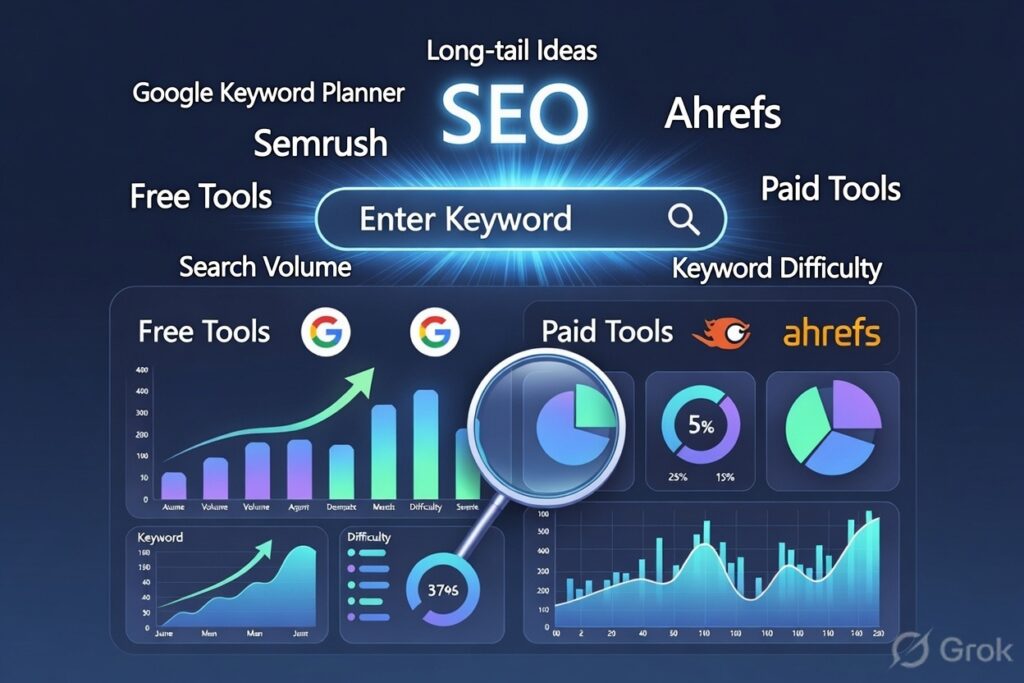
This Keyword Research Guide explains everything you need to know—from understanding keyword types and search intent to finding high-traffic, low-competition keywords using both free and paid tools. By the end of this guide, you’ll have a practical framework that you can apply to every SEO campaign and content strategy.
What Is Keyword Research?
Keyword research is the process of identifying the words and phrases that people type into search engines when looking for information, products, or services. These search terms help businesses understand user interests and create content that answers specific questions or solves real problems.
Every search begins with a keyword. Someone may search for a broad topic such as “digital marketing,” while another person searches for a more specific phrase like “best digital marketing agency for small businesses.” Each keyword represents a different level of intent and opportunity.
The primary goals of keyword research include:
- Understanding what your audience is searching for.
- Measuring search demand for specific topics.
- Evaluating keyword competition.
- Discovering long-tail keyword opportunities.
- Planning content that aligns with user intent.
- Increasing organic traffic from search engines.
- Supporting long-term SEO growth.
Keyword research is not simply about finding high-volume search terms. The best keywords balance search demand, competition, relevance, and business goals. This balance enables websites to attract qualified visitors who are more likely to engage with the content or become customers.
Why Keyword Research Matters for SEO?
Keyword research is one of the most important steps in search engine optimization because it influences nearly every aspect of your SEO strategy.
Helps You Understand Your Audience
Every keyword reflects a real question, problem, or need. By analyzing search queries, you gain valuable insight into what your audience wants, the language they use, and the information they expect to find.
For example, someone searching for “what is keyword research” is looking for educational content, while a search for “best keyword research tools” indicates that the user is comparing solutions before making a decision.
Understanding these differences helps you create content that satisfies search intent instead of simply targeting keywords.
Improves Organic Rankings
Search engines aim to provide the most relevant content for every search query. When your pages are optimized around well-researched keywords and genuinely answer users’ questions, they have a better chance of appearing higher in search results.
Well-planned keyword targeting also reduces keyword cannibalization, where multiple pages on the same website compete for the same search term.
Increases Qualified Traffic
Ranking for thousands of irrelevant keywords offers little value if visitors are not interested in your products or services. Keyword research focuses on attracting qualified traffic—people who are actively looking for what you provide. This often results in higher engagement, more inquiries, and better conversion rates.
Supports Content Planning
Instead of publishing random articles, keyword research enables you to build a structured content strategy.
For example, a digital marketing website could organize content into topic clusters such as:
- Keyword Research Guide
- On-Page SEO Guide
- Technical SEO Guide
- Local SEO Guide
- Link Building Guide
This approach strengthens topical authority and improves internal linking.
Helps Identify New Opportunities
Keyword trends change continuously as industries evolve and user behavior shifts. Regular keyword research helps you identify emerging topics before they become highly competitive, giving your website a better chance to establish authority early.
Understanding Search Intent
Search intent, also known as user intent, refers to the purpose behind a search query. Modern SEO is no longer about matching keywords alone; it’s about understanding what users actually want when they search.
Creating content that aligns with search intent significantly improves user satisfaction and increases your chances of ranking well.
1. Informational Intent
Users want to learn about a topic or find answers to specific questions.
Examples include:
- What is keyword research?
- How does SEO work?
- Benefits of content marketing
The best content for informational intent includes comprehensive guides, tutorials, blog posts, and educational resources.
2. Navigational Intent
Users already know where they want to go and use search engines to find a specific website or page.
Examples include:
- Google Search Console login
- Ahrefs blog
- Google Keyword Planner
These searches are brand-focused rather than topic-focused.
3. Commercial Investigation
Users are researching products or services before making a purchase. They compare options, read reviews, and evaluate features.
Examples include:
- Best keyword research tools
- Ahrefs vs Semrush
- SEO software comparison
Comparison articles, buying guides, feature comparisons, and case studies perform well for this type of search intent.
4. Transactional Intent
Users are ready to take action, such as purchasing a product, requesting a quote, or signing up for a service.
Examples include:
- Buy SEO tools
- Hire SEO agency
- Keyword research services
Landing pages, pricing pages, service pages, and product pages are the most effective content formats for transactional keywords.
Understanding search intent before selecting keywords ensures that every page you publish meets user expectations. Search engines increasingly prioritize content that fully satisfies the reason behind a search rather than content that simply repeats a keyword multiple times.
Step-by-Step Keyword Research Process
Keyword research is more than finding popular search terms. A structured process helps you identify keywords that are relevant to your business, align with user intent, and have the potential to drive qualified organic traffic.
Follow these steps to build a keyword strategy that supports long-term SEO success.
Step 1: Define Your Goals
Before searching for keywords, determine what you want to achieve.
Ask yourself:
- Are you trying to increase website traffic?
- Do you want to generate leads?
- Are you promoting products or services?
- Are you building topical authority?
- Are you creating educational content?
Your objectives influence the types of keywords you should target.
For example:
| Goal | Recommended Keyword Type |
| Increase blog traffic | Informational keywords |
| Generate leads | Commercial keywords |
| Sell products | Transactional keywords |
| Build brand awareness | High-volume informational topics |
| Improve local visibility | Local keywords |
When your goals are clear, keyword selection becomes much easier.
Step 2: Create a List of Seed Keywords
Seed keywords are broad topics related to your business. They act as the starting point for discovering hundreds or even thousands of keyword ideas.
If you own a digital marketing agency, your seed keywords might include:
- Keyword Research
- Content Marketing
- Link Building
- Technical SEO
- Local SEO
- Google Ads
- Social Media Marketing
If you run an online clothing store:
- Men’s shirts
- Women’s shoes
- Summer dresses
- Jackets
- Sneakers
Don’t worry about search volume at this stage. Focus on listing every topic relevant to your niche.
Step 3: Expand Your Keyword Ideas
Once you have your seed keywords, begin expanding them into more specific search queries.
Google Autocomplete
Start typing a keyword into Google.
For example:
keyword research…
Google may suggest:
- keyword research guide
- keyword research tools
- keyword research checklist
- keyword research process
- keyword research for beginners
These suggestions are based on real user searches, making them valuable sources of keyword ideas.
People Also Ask
The “People Also Ask” section contains common questions related to your topic.
Examples include:
- Why is keyword research important?
- What is a good keyword difficulty score?
- How many keywords should a page target?
- Which keyword tool is free?
Each question can become a dedicated section in your article or even a separate blog post.
Related Searches
Scroll to the bottom of Google’s search results to find related searches.
For “keyword research,” you might see:
- free keyword research tools
- keyword planner
- SEO keyword ideas
- long-tail keywords
- keyword strategy
These related searches reveal additional topics your audience is interested in.
Google Trends
Google Trends helps you understand how search interest changes over time.
Use it to:
- Identify rising topics.
- Compare keyword popularity.
- Discover seasonal trends.
- Find region-specific interest.
Publishing content before a topic becomes highly competitive can help you gain an early ranking advantage.
Step 4: Analyze Search Intent
Every keyword should match the purpose behind the user’s search.
Consider these examples:
Informational Keyword:
“what is keyword research?”
Content format:
- Blog post
- Guide
- Tutorial
Commercial Keyword:
“best keyword research tools”
Content format:
- Comparison article
- Reviews
- Buying guide
Transactional Keyword:
“keyword research services”
Content format:
- Service page
- Landing page
- Contact page
Choosing the wrong content format often prevents a page from ranking, even if the keyword is relevant.
Step 5: Check Search Volume
Search volume indicates the average number of monthly searches for a keyword.
Example:
| Keyword | Monthly Searches |
| SEO | 90,000 |
| Keyword Research | 22,000 |
| Keyword Research Guide | 2,000 |
| Keyword Research Checklist | 350 |
Higher search volume can bring more traffic, but it usually comes with stronger competition.
Don’t ignore lower-volume keywords. Many long-tail keywords attract highly qualified visitors and are easier to rank for.
Step 6: Evaluate Keyword Difficulty
Keyword difficulty estimates how challenging it may be to rank on the first page for a keyword.
Although each SEO tool calculates difficulty differently, the concept remains the same.
Low Difficulty
- Easier rankings
- Ideal for new websites
Medium Difficulty
- Requires quality content
- Needs backlinks
- Strong on-page optimization
High Difficulty
Usually dominated by:
- Large brands
- Established websites
- Authoritative industry publications
For new websites, targeting lower-difficulty keywords is often a more effective strategy.
Step 7: Consider Business Relevance
A keyword should not only generate traffic but also support your business objectives.
Example:
Suppose your agency provides SEO services.
These keywords are highly relevant:
- SEO consultant
- SEO audit
- Keyword research guide
- On-page SEO
However, a high-volume keyword such as:
“free movies online”
may generate traffic but has no connection to your business.
Always prioritize relevance over raw search volume.
Step 8: Analyze Competitor Keywords
Studying competitor websites helps you identify opportunities you may have overlooked.
Review:
- Their highest-ranking pages
- Frequently covered topics
- Common keywords
- Content structure
- Internal linking strategy
- Featured snippets
- FAQs
Ask yourself:
- Which keywords are they targeting?
- What information is missing?
- Can you create a more comprehensive and helpful resource?
Your goal is not to copy competitors but to create content that delivers greater value.
Step 9: Find Long-Tail Opportunities
Long-tail keywords often represent users with clear intent.
Instead of targeting:
SEO
Consider:
- SEO checklist for beginners
- Local SEO guide for small businesses
- How to improve website rankings
- Keyword research guide for bloggers
Long-tail keywords typically have:
- Lower competition
- Higher conversion rates
- Better engagement
- More specific user intent
They are especially valuable for newer websites building authority.
Step 10: Select Your Primary Keyword
Choose one primary keyword for each page.
A strong primary keyword should:
- Match the page’s main topic.
- Align with search intent.
- Have realistic competition.
- Offer meaningful search demand.
- Support your business goals.
For this guide:
Primary Keywordis Keyword Research Guide
Step 11: Choose Supporting Keywords
Next, identify related keywords that naturally support your primary keyword.
Examples:
- SEO keyword research
- keyword research tools
- keyword strategy
- search volume
- keyword difficulty
- search intent
- long-tail keywords
- competitor analysis
- topic clusters
- content planning
Supporting keywords help search engines understand the breadth and depth of your content.
Step 12: Build a Keyword List
Organize your research into a spreadsheet.
Recommended columns include:
| Keyword | Intent | Search Volume | Difficulty | Priority | Target Page |
| Keyword Research Guide | Informational | High | Medium | High | Pillar Guide |
| Keyword Research Tools | Commercial | High | High | Medium | Blog |
| Keyword Clustering | Informational | Medium | Low | High | Blog |
| Search Intent | Informational | Medium | Medium | High | Blog |
Maintaining a structured keyword database makes future content planning more efficient.
Tips for Choosing the Right Keywords
Keep these best practices in mind:
- Prioritize user intent over search volume.
- Focus on topics that match your expertise.
- Target long-tail keywords for faster ranking opportunities.
- Balance high-volume and low-competition terms.
- Create one primary topic per page.
- Use supporting keywords naturally.
- Review and update your keyword research regularly as search trends evolve.
Keyword research is an ongoing process rather than a one-time task. As your website grows, continue discovering new opportunities, refining existing content, and expanding your topical authority.
In the next section, we’ll explore the most effective free and paid keyword research tools, explain how to use them, and compare their strengths, helping you choose the right tools for your SEO workflow.
Best Keyword Research Tools
Keyword research tools help you discover new keyword opportunities, estimate search demand, measure competition, analyze competitors, and build a strong content strategy. While no single tool is perfect, using a combination of free and paid tools provides the most comprehensive insights.
Let’s explore the most popular keyword research tools and how to use them effectively.
Free Keyword Research Tools
If you’re just starting with SEO or have a limited budget, several free tools can provide valuable keyword insights.
Google Search
One of the best keyword research tools is Google Search itself.
Simply type a topic into the search bar and observe:
- Google Autocomplete suggestions
- People Also Ask questions
- Related Searches
- Featured Snippets
- AI Overviews (when available)
- Search refinements
These features are based on real user searches and can inspire new content ideas.
Best For
- Finding long-tail keywords
- Understanding search intent
- Discovering FAQs
- Identifying related topics
Google Keyword Planner
Google Keyword Planner is designed for advertisers, but it is also useful for SEO professionals.
It provides:
- Keyword ideas
- Monthly search estimates
- Competition levels
- Cost Per Click (CPC)
- Forecasts
Although search volume is often presented in ranges for free accounts, it remains a valuable starting point.
Best For
- Search volume estimates
- Commercial keyword research
- PPC and SEO planning
Google Trends
Google Trends helps identify changes in search interest over time.
You can:
- Compare multiple keywords
- Discover trending searches
- Analyze seasonal demand
- Find region-specific popularity
Example: Compare:
- SEO
- Digital Marketing
- Content Marketing
You can quickly identify which topic is gaining popularity and which one is declining.
Best For
- Seasonal planning
- Trending topics
- Regional keyword research
Google Search Console
Google Search Console is one of the most valuable SEO tools because it shows the keywords your website is already ranking for.
You can discover:
- Impressions
- Clicks
- Average position
- Click-through rate (CTR)
This data helps identify pages that are close to ranking on the first page and need only minor optimization.
Best For
- Existing keyword performance
- Content optimization
- Finding hidden ranking opportunities
Google Analytics
Although Google Analytics does not directly display keyword data, it helps you understand how visitors interact with your content.
Important metrics include:
- Organic traffic
- Engagement time
- Bounce rate
- Conversions
- Landing pages
By combining Analytics with Search Console, you gain a clearer picture of how keyword rankings translate into user behavior.
Best For
- Measuring SEO performance
- Understanding visitor engagement
- Tracking conversions
Paid Keyword Research Tools
Paid SEO tools offer more detailed data, advanced competitor analysis, and extensive keyword databases.
For businesses that rely heavily on organic traffic, these tools are often worth the investment.
Ahrefs
Ahrefs is widely recognized as one of the most comprehensive SEO platforms.
Key features include:
- Keyword Explorer
- Keyword Difficulty
- Search Volume
- Traffic Potential
- Click Metrics
- Parent Topics
- Backlink Analysis
- Site Explorer
- Content Explorer
One standout feature is Traffic Potential, which estimates the broader traffic a page could receive by ranking for a topic—not just a single keyword.
Best For
- Advanced keyword research
- Competitor analysis
- Backlink research
- Content planning
Semrush
Semrush is another leading SEO platform that supports keyword research, content planning, advertising, and competitor analysis.
Popular features include:
- Keyword Magic Tool
- Keyword Overview
- Organic Research
- Keyword Gap
- Position Tracking
- Topic Research
- SEO Writing Assistant
The Keyword Gap tool is particularly useful for identifying keywords your competitors rank for that your website does not.
Best For
- Competitive keyword analysis
- Content marketing
- Enterprise SEO
- Position tracking
Moz Keyword Explorer
Moz provides reliable keyword research with a clean and beginner-friendly interface.
Metrics include:
- Search Volume
- Keyword Difficulty
- Organic CTR
- Priority Score
The Priority Score combines several metrics to help you decide which keywords deserve attention first.
Best For
- Beginner-friendly SEO
- Keyword prioritization
- Content planning
Ubersuggest
Ubersuggest is a budget-friendly SEO platform suitable for freelancers, bloggers, and small businesses.
It provides:
- Keyword ideas
- Search volume
- SEO difficulty
- Paid difficulty
- CPC estimates
- Content ideas
- Competitor analysis
Although its database is smaller than Ahrefs or Semrush, it remains a practical choice for many users.
Best For
- Small businesses
- Bloggers
- Affordable keyword research
KeywordTool.io
KeywordTool.io generates hundreds of keyword ideas using Google Autocomplete and other search engines.
It also supports:
- YouTube
- Amazon
- Bing
- TikTok
- eBay
This makes it useful for businesses targeting multiple platforms.
Best For
- Long-tail keyword discovery
- YouTube SEO
- Ecommerce SEO
AnswerThePublic
AnswerThePublic visualizes search queries in the form of questions, comparisons, and prepositions.
Examples include:
- What is keyword research?
- Why is keyword research important?
- How does keyword research work?
- Which keyword research tool is best?
These questions are excellent sources for blog posts and FAQ sections.
Best For
- Content ideation
- FAQ generation
- Informational keywords
Choosing the Right Tool
Each tool has different strengths. The best choice depends on your goals and budget.
| Tool | Free/Paid | Best For |
| Google Search | Free | Keyword ideas and search intent |
| Google Keyword Planner | Free | Search volume and CPC |
| Google Trends | Free | Trending and seasonal keywords |
| Google Search Console | Free | Existing rankings and optimization |
| Google Analytics | Free | SEO performance and engagement |
| Ahrefs | Paid | Advanced SEO and backlink analysis |
| Semrush | Paid | Competitor research and keyword gap analysis |
| Moz Keyword Explorer | Paid | Keyword prioritization |
| Ubersuggest | Freemium | Budget-friendly keyword research |
| KeywordTool.io | Freemium | Long-tail keyword discovery |
| AnswerThePublic | Freemium | Question-based keyword ideas |
How to Combine Multiple Tools?
Professional SEO specialists rarely rely on a single platform. Instead, they combine tools to build a complete picture of keyword opportunities.
A practical workflow might look like this:
- Brainstorm ideas using Google Search and Autocomplete.
- Validate search demand with Google Keyword Planner.
- Check seasonal trends using Google Trends.
- Analyze competitor keywords with Ahrefs or Semrush.
- Review your own website’s performance in Google Search Console.
- Measure user engagement and conversions with Google Analytics.
- Organize your keyword list into a spreadsheet or content planning tool.
Using multiple tools helps you make informed decisions based on real data rather than assumptions.
Key Metrics to Evaluate
When researching keywords, don’t focus only on search volume. Consider several metrics together.
Search Volume
The estimated number of monthly searches for a keyword.
Keyword Difficulty
An estimate of how difficult it is to rank for the keyword.
Search Intent
The reason behind a user’s search—informational, navigational, commercial, or transactional.
Cost Per Click (CPC)
The average amount advertisers pay for a click. A higher CPC often indicates stronger commercial value.
Click-Through Rate (CTR)
Some search results receive fewer clicks due to ads, featured snippets, or AI-generated answers. Consider how these SERP features may affect traffic.
Trend
Analyze whether search interest is growing, stable, or declining over time.
Evaluating these metrics together helps you identify keywords that are both achievable and valuable.
Pro Tips for Better Keyword Research
- Don’t choose keywords based on search volume alone.
- Look for long-tail opportunities with clear search intent.
- Study the top-ranking pages before creating content.
- Regularly update your keyword research as trends change.
- Build topic clusters around your primary keywords.
- Monitor rankings and refine your strategy based on performance data.
Keyword research is an ongoing process. As your website grows and search behavior evolves, revisiting your keyword strategy will help you uncover new opportunities and maintain strong organic visibility.
In the next section, you’ll learn how to analyze competitor keywords, organize keywords into topic clusters, map them to website pages, and build an SEO content strategy that supports long-term growth.
Competitor Keyword Analysis
One of the fastest ways to discover valuable keyword opportunities is by analyzing the websites that already rank well in your niche. Competitor keyword analysis helps you understand what topics are driving traffic to competing websites and where you can create better, more comprehensive content.
The goal isn’t to copy competitors—it is to identify opportunities they may have missed and produce content that provides greater value to users.
Identify Your SEO Competitors
Your business competitors and SEO competitors are not always the same.
For example, if you run a digital marketing agency, your SEO competitors include websites that rank for keywords such as:
- keyword research guide
- on-page SEO
- technical SEO
- local SEO
- SEO checklist
Search your primary keywords in Google and note the websites consistently appearing on the first page. These are the competitors whose content, keyword strategy, and site structure you should study.
Analyze Their Top-Performing Pages
Review the pages that attract the most organic traffic.
Look for patterns such as:
- Topics they cover frequently
- Types of content they publish
- Average article length
- Heading structure
- Images, charts, and videos
- Frequently asked questions
- Internal linking
- Calls to action
Ask yourself:
- Why is this page ranking?
- What information is missing?
- How can I make my content more useful?
Rather than creating a similar article, aim to produce a more complete, better-organized, and up-to-date resource.
Study Their Keywords
SEO tools such as Ahrefs and Semrush can reveal:
- Primary keywords
- Secondary keywords
- Estimated traffic
- Ranking positions
- Featured snippets
- Top-performing pages
This information helps you discover keywords you may not have considered.
Keyword Gap Analysis
Keyword gap analysis identifies keywords that your competitors rank for but your website does not.
For example:
| Competitor Keyword | Your Website |
| Keyword Research Guide | ✅ |
| Keyword Clustering | ❌ |
| Search Intent Guide | ❌ |
| SEO Content Strategy | ❌ |
| Keyword Mapping | ❌ |
Each missing keyword represents a potential content opportunity.
Prioritize keywords that:
- Match your niche
- Have clear search intent
- Support your business goals
- Fit naturally into your content strategy
Keyword Clustering
Keyword clustering is the process of grouping closely related keywords so that a single page can rank for multiple search queries.
Instead of creating separate pages for every variation, group similar keywords together.
Example Cluster
Primary Keyword
Keyword Research Guide
Supporting Keywords
- SEO keyword research
- keyword research process
- keyword research checklist
- keyword analysis
- keyword planning
- SEO keyword strategy
- how to do keyword research
All of these keywords can be naturally covered within one comprehensive guide.
This approach avoids duplicate content and strengthens topical authority.
Keyword Mapping
Keyword mapping assigns each keyword to the most appropriate page on your website.
Without keyword mapping, multiple pages may compete for the same keyword, reducing your overall ranking potential.
Example Keyword Map
| Target Page | Primary Keyword |
| Homepage | Digital Marketing Agency |
| Services Page | SEO Services |
| Pillar Guide | Keyword Research Guide |
| Blog | Keyword Clustering |
| Blog | Search Intent Explained |
| Blog | Local SEO Checklist |
Each page should focus on one primary keyword while naturally incorporating related terms.
Build Topic Clusters
Topic clusters organize your content around a central pillar page and related supporting articles.
This structure helps search engines understand your expertise and improves internal linking.
Example SEO Topic Cluster
Pillar Page
Keyword Research Guide
Cluster Articles
- What Is Search Intent?
- Long-Tail Keywords Explained
- Keyword Difficulty Guide
- Best Free Keyword Research Tools
- Best Paid SEO Tools
- Competitor Keyword Analysis
- Keyword Clustering Guide
- Keyword Mapping Explained
- How to Use Google Search Console for SEO
- Common Keyword Research Mistakes
Each cluster article links back to the pillar guide, and the pillar guide links to the cluster articles.
This creates a strong internal linking structure that supports topical authority.
Create a Content Calendar
Publishing content consistently is just as important as choosing the right keywords.
A content calendar helps you:
- Maintain a regular publishing schedule
- Cover topics systematically
- Avoid duplicate content
- Balance evergreen and trending content
- Track article progress
Example Monthly Plan
| Week | Topic |
| Week 1 | Keyword Research Guide |
| Week 2 | Search Intent Guide |
| Week 3 | Keyword Clustering |
| Week 4 | Competitor Keyword Analysis |
As your website grows, continue expanding each topic cluster with supporting articles.
Prioritize Keywords
Not every keyword deserves equal attention.
Consider these factors when deciding which keywords to target first:
Business Value
Does the keyword support your products or services?
Search Intent
Does the content match what users expect?
Competition
Can your website realistically compete for the keyword?
Search Volume
Is there enough demand to justify creating content?
Topical Relevance
Does the keyword strengthen your website’s authority within its niche?
A keyword with moderate search volume and low competition often delivers better long-term results than an extremely competitive, high-volume keyword.
Measure Keyword Performance
Keyword research doesn’t end after publishing your content.
Monitor performance using tools such as Google Search Console and Google Analytics.
Track metrics including:
- Keyword rankings
- Organic traffic
- Click-through rate (CTR)
- Impressions
- User engagement
- Conversions
- Bounce rate
- Average engagement time
Review your performance regularly to identify opportunities for improvement.
Update Existing Content
SEO is an ongoing process.
Instead of publishing only new articles, regularly improve your existing content.
Updates may include:
- Adding new statistics
- Refreshing screenshots
- Expanding sections
- Answering new user questions
- Improving internal links
- Optimizing headings
- Including recently discovered keywords
Search engines often reward fresh, comprehensive, and regularly updated content.
Build Topical Authority
Topical authority is established when your website consistently publishes high-quality content covering all aspects of a subject.
For example, rather than publishing a single article about keyword research, create an interconnected library of resources.
A strong keyword research content hub could include:
- Keyword Research Guide (Pillar Page)
- Search Intent Guide
- Keyword Difficulty Guide
- Keyword Clustering Guide
- Keyword Mapping Guide
- Google Keyword Planner Tutorial
- Google Search Console Guide
- Competitor Keyword Analysis Guide
- Long-Tail Keyword Guide
- SEO Content Planning Guide
As these pages link to one another and comprehensively cover the topic, search engines gain greater confidence in your website’s expertise.
Best Practices for Long-Term Success
To build a sustainable keyword strategy:
- Perform keyword research before creating new content.
- Focus on solving users’ problems rather than simply targeting keywords.
- Group related keywords into comprehensive pages.
- Avoid creating multiple pages targeting the same primary keyword.
- Publish high-quality content consistently.
- Strengthen internal linking between related articles.
- Review keyword performance every few months.
- Refresh older content with updated information and newly discovered keywords.
Keyword research is not a one-time activity. As search behavior changes and your website grows, regularly refining your keyword strategy will help maintain and improve your search visibility.
In the final part of this guide, you’ll learn the most common keyword research mistakes to avoid, follow a practical keyword research checklist, find answers to frequently asked questions, and discover actionable tips you can apply immediately to improve your SEO strategy.
Common Keyword Research Mistakes to Avoid
Even experienced SEO professionals make keyword research mistakes that can limit a website’s organic growth. Avoiding these common pitfalls will help you create a more effective keyword strategy and improve your chances of ranking in search results.
1. Targeting Only High-Volume Keywords
Many beginners assume that keywords with the highest search volume will generate the best results.
In reality, these keywords are often highly competitive and dominated by authoritative websites.
Instead of focusing solely on search volume, look for keywords that balance:
- Search volume
- Keyword difficulty
- Search intent
- Business relevance
A keyword with 500 monthly searches and low competition may deliver better results than one with 50,000 searches and extremely high competition.
2. Ignoring Search Intent
One of the biggest SEO mistakes is creating content that doesn’t match what users expect.
For example, if users search for: Best Keyword Research Tools
They expect:
- Comparisons
- Reviews
- Features
- Pricing
- Pros and cons
Publishing a basic definition of keyword research is unlikely to satisfy that intent.
Always analyze the top-ranking pages before creating your content.
3. Keyword Stuffing
Repeating the same keyword excessively no longer improves rankings.
Instead of writing:
“Keyword research guide helps with keyword research because keyword research guide is important…”
Write naturally using:
- Related phrases
- Synonyms
- Semantic keywords
- Clear explanations
Modern search engines understand context, so prioritize readability over keyword repetition.
4. Creating Multiple Pages for the Same Keyword
Publishing several articles targeting the same primary keyword can cause keyword cannibalization, where your own pages compete against each other.
For example, avoid creating separate pages like:
- Keyword Research Guide
- Complete Keyword Research Guide
- Ultimate Keyword Research Guide
Instead, publish one comprehensive pillar page and support it with related cluster articles that target different but closely connected topics.
5. Not Updating Existing Content
SEO is an ongoing process. Search behavior, algorithms, and industry trends change over time.
Review older content regularly by:
- Refreshing statistics
- Adding new sections
- Improving examples
- Updating screenshots
- Including new keywords
- Enhancing internal links
Regular updates help maintain relevance and improve long-term rankings.
6. Ignoring Long-Tail Keywords
Long-tail keywords often have lower competition and stronger conversion potential.
For example, instead of targeting: SEO
Consider:
- SEO checklist for beginners
- Local SEO guide for small businesses
- Technical SEO audit checklist
- Keyword research guide for bloggers
These specific queries attract visitors who know exactly what they’re looking for.
7. Not Tracking Performance
Publishing content without monitoring results means missing opportunities for improvement.
Review your keyword performance regularly using tools such as Google Search Console and Google Analytics.
Track:
- Rankings
- Organic traffic
- Click-through rate (CTR)
- Impressions
- Conversions
Use this data to refine your content and keyword strategy.
Keyword Research Checklist
Use this checklist every time you plan a new article or website page.
1. Identify your target audience.
2. Define the goal of the page.
3. Brainstorm seed keywords.
4. Expand keyword ideas using Google Search and SEO tools.
5. Analyze search intent.
6. Check search volume.
7. Evaluate keyword difficulty.
8. Study competitor content.
9. Choose one primary keyword.
10. Select supporting and semantic keywords.
11. Create a keyword cluster.
12. Map the keyword to the correct page.
13. Optimize the title, headings, and meta description.
14. Add internal links to related content.
15. Publish high-quality, user-focused content.
16. Monitor rankings and update the page regularly.
Following this checklist consistently will help you build a strong SEO foundation.
Frequently Asked Questions
What is keyword research?
Keyword research is the process of identifying the words and phrases people use in search engines so you can create content that matches their needs and improves your chances of ranking in search results.
Why is keyword research important?
Keyword research helps you understand your audience, create relevant content, improve organic visibility, attract qualified traffic, and support long-term SEO growth.
How often should I perform keyword research?
Keyword research should be an ongoing activity. Review your keyword strategy regularly and update it whenever search trends, business goals, or customer interests change.
What is a good keyword difficulty score?
There is no universal benchmark because each SEO tool calculates difficulty differently. Generally, newer websites should begin with lower-difficulty keywords before targeting highly competitive terms.
Should I target multiple keywords on one page?
Yes. Each page should have one primary keyword supported by related secondary and semantic keywords, provided they all align with the same search intent.
What are long-tail keywords?
Long-tail keywords are longer, more specific search phrases that typically have lower competition and higher conversion potential because they closely match user intent.
Which free keyword research tools are best?
Popular free tools include:
- Google Search
- Google Keyword Planner
- Google Trends
- Google Search Console
- Google Analytics
Using these tools together provides valuable insights for most SEO projects.
Which paid keyword research tool is best?
There is no single best tool for every situation.
Many SEO professionals use platforms such as Ahrefs or Semrush because they combine keyword research, competitor analysis, backlink insights, and rank tracking in one place.
The right choice depends on your budget, workflow, and business requirements.
How many keywords should a page target?
Rather than aiming for a specific number, focus on one primary keyword and naturally include relevant secondary and semantic keywords that help cover the topic comprehensively.
Can I rank without keyword research?
While it’s possible for some pages to rank naturally, keyword research significantly increases your chances of attracting the right audience and building a sustainable SEO strategy.
Summarizing All
Before publishing your next piece of content, remember these essential principles:
- Start with clear business goals.
- Understand your audience’s search intent.
- Build your research from strong seed keywords.
- Prioritize relevance over search volume.
- Use long-tail keywords to discover realistic ranking opportunities.
- Analyze competitor content for inspiration, not imitation.
- Group related keywords into topic clusters.
- Assign one primary keyword to each page.
- Monitor performance and improve your content over time.
- Treat keyword research as an ongoing process rather than a one-time task.
Consistently applying these practices will help you create content that serves users effectively and supports long-term organic growth.
Ready to Improve Your SEO with Smarter Keyword Research?
Keyword research is the foundation of every successful SEO strategy. It helps you understand your audience, identify valuable search opportunities, and create content that aligns with user intent.
Rather than chasing the highest search volume, focus on choosing keywords that are relevant, achievable, and aligned with your business objectives. Combine those keywords with well-structured, high-quality content, a logical internal linking strategy, and regular content updates to build sustainable search visibility.
SEO is constantly evolving, and keyword research should evolve with it. Continue monitoring search trends, analyzing competitors, and refining your content strategy to stay ahead. Over time, a disciplined approach to keyword research will help you build topical authority, attract qualified visitors, and create lasting organic growth.
Whether you’re a beginner launching your first website or an experienced marketer refining an existing strategy, mastering keyword research is one of the most valuable skills you can develop for long-term SEO success.
At AdsnSEO Digital Marketing, we help businesses improve their online visibility through data-driven keyword research, on-page SEO, technical SEO, content marketing, and long-term organic growth strategies.
If you’re looking to attract more qualified traffic and strengthen your search presence, our team can help you create an SEO strategy tailored to your business goals.