Local Digital marleting helps your business show up exactly when nearby customers are searching for what you offer. Most people now check online before they visit a shop, book an appointment, or call a service provider often on a phone, often while they’re already out and looking for something close by. This guide covers the full picture: how local search actually works, how to optimize your Google Business Profile, how to build local citations and NAP consistency, how to write local content that ranks, and how to run geo-targeted ads that bring in leads faster.
What Is Local Digital Marketing?
Local digital marketing means promoting your business to people in a specific area instead of a broad, global audience. It’s sometimes called hyperlocal marketing when it narrows down to a neighborhood or a few-kilometer radius. The goal is the same either way: get your business seen in the searches, maps, and feeds of people close enough to actually visit or call you.
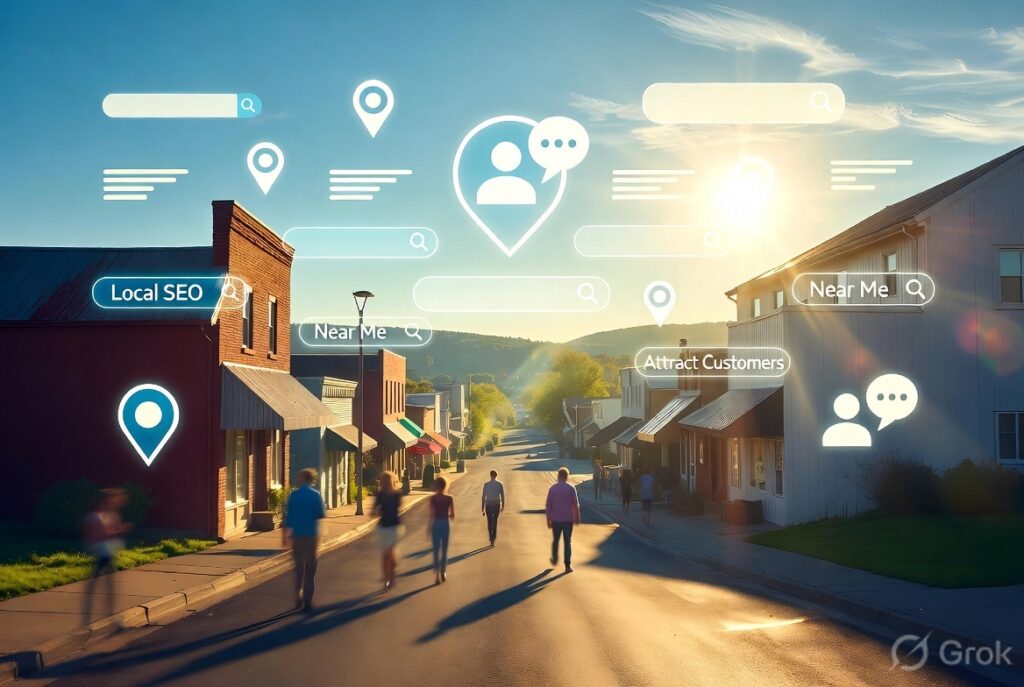
For example, when someone searches “best digital marketing services near me” or “dentist near Chandanagar,” search engines pull up a set of nearby businesses often shown as a map with three listings above the regular results. This is usually called the Local Pack or Google Local Pack, and getting into it is one of the biggest wins in local SEO. Ranking here brings in customers who are ready to act, not just casually browsing.
Local digital marketing isn’t one single tactic. It’s a combination of local search engine optimization, Google Business Profile management, local content, community-based link building, reputation management, and paid geo-targeted ads all aimed at the same goal, visibility within your service area.
How Local Search Actually Works: Ranking Factors You Should Know?
Before getting into tactics, it helps to understand what Google is actually measuring when it decides which businesses to show for a “near me” search. Local search ranking factors generally come down to three things:
Relevance — how well your business profile and website match what someone is searching for. This is where accurate categories, keywords, and service descriptions matter.
Distance — how close your business is to the person searching, or to the location mentioned in the search. You can’t change your physical location, but you can make sure Google knows exactly where it is.
Prominence — how well-known and well-reviewed your business is, both online and offline. This includes your review count and rating, your local citations, your backlinks, and general brand mentions across the web.
Most local SEO work is really just improving these three signals in different ways, a well-optimized Google Business Profile improves relevance and prominence, local citations and NAP consistency improve trust signals tied to prominence, and local content improves relevance for a wider range of location-based searches.
Why Local Marketing Matters?
Many businesses try to reach everyone at once with broad, generic marketing. For a local service like a clinic, a gym, a restaurant, a real estate agency, a home services business this rarely works as well as focusing tightly on your actual service area.
Local marketing helps you:
- Reach the right audience instead of a broad, unqualified one
- Increase visibility specifically within your city or neighborhood
- Generate leads that are ready to buy, not just researching
- Build trust within your community through reviews, local content, and local partnerships
- Compete more effectively, since you’re up against nearby businesses instead of the entire market
It also tends to cost less than broad-market marketing, since your ad budgets and content efforts aren’t spread across audiences who could never realistically become customers.
Building a Local Digital Marketing Strategy: The Core Components
A complete local digital marketing strategy combines several moving parts. None of them work particularly well alone. A great Google Business Profile with no reviews won’t rank, and great local content on a slow, unoptimized website won’t convert. Here’s how each piece fits together.
1. Optimize Your Google Business Profile
Your Google Business Profile (formerly Google My Business) is often the first thing a potential customer sees before they visit, call, or message you. Google Business Profile optimization is one of the highest-leverage local SEO activities you can do, and it costs nothing but time.
A properly optimized profile includes:
- Accurate business name, address, and phone number (this needs to exactly match what’s on your website and other listings — more on that below)
- The correct primary category, plus relevant secondary categories
- A complete, keyword-aware business description
- Real photos of your location, team, and work — not stock images
- Updated hours, including holiday hours
- A full list of products or services with descriptions
- Regular Google Posts (updates, offers, events) to keep the profile active
- Prompt responses to the Q&A section and to messages
Encourage happy customers to leave reviews consistently, not just occasionally. Reviews influence both prominence (Google’s ranking signal) and simple human trust. Most people read reviews before they read anything else about your business.
2. Local Keyword Research and Location-Based Keywords
Keyword research matters for every digital marketing strategy, but local keyword research has its own layer: location modifiers. Instead of targeting a generic term like “digital marketing services,” you’d target “digital marketing services in Hyderabad” or “SEO agency near Chandanagar.”
A few patterns worth building into your keyword list:
- City or area + service: “SEO agency Chandanagar,” “website design Hyderabad”
- “Near me” variations: these are usually handled automatically by Google based on the searcher’s location, but your content should still use natural location language so it matches the intent
- Neighborhood-level modifiers: useful if you serve a specific part of a larger city
- Comparison and intent-based local terms: “best,” “affordable,” “top-rated” combined with your service and area
3. Local Content Marketing
Content that speaks directly to your local audience consistently outperforms generic, one-size-fits-all articles for local search intent. This is sometimes called local content marketing, and it works because it gives Google and your actual readers very specific, hard-to-fake relevance signals.
Ideas that work well here:
- Location pages: if you serve multiple areas or have multiple branches, a dedicated page per location (with unique content, not a copy-paste template) helps each location rank independently
- Local guides: “Best areas to open a [business type] in Hyderabad,” or a guide relevant to your niche and city
- Local case studies: results you’ve delivered for a client in the same city or region carry more weight with local prospects
- City or neighborhood-specific FAQs: answering questions specific to your area (parking, timing, local regulations, etc.)
This approach does two things at once, it improves your local SEO through fresh, geo-relevant content, and it shows your audience you actually understand their situation, not just your product.
4. NAP Consistency and Local Citations
NAP stands for Name, Address, Phone number and consistency here across every place your business appears online is one of the more overlooked local SEO ranking factors. If your Google Business Profile lists one phone number, your website lists another, and a directory listing has an old address, it creates confusion for both users and search engines, and it can quietly hurt your rankings.
Local citations are simply mentions of your business’s NAP information on other websites like directories, review platforms, industry-specific listings, and local business associations. Common places to build citations include:
- Google Business Profile and Bing Places
- General directories like Justdial and Sulekha
- Industry-specific directories relevant to your niche
- Local Chamber of Commerce or business association listings
- Review platforms relevant to your industry
Building citations isn’t a one-time task, it’s worth periodically auditing your existing listings to catch outdated information, especially after you move locations, change your phone number, or rebrand.
5. Local Link Building and Community Partnerships
Local link building focuses on getting other, relevant local websites to link back to yours — a strong prominence signal for local search rankings, and genuinely useful for actual referral traffic too.
Ways to build local links and community connections:
- Partner with complementary (non-competing) local businesses for cross-promotion
- Sponsor or participate in local events, and ask for a mention/link on the event’s website
- Join local business groups, chambers of commerce, or industry associations
- Get featured in local news sites, blogs, or “best of [city]” roundup articles
- Offer to write a guest post or expert quote for a locally-focused publication
These connections build credibility that’s difficult to replicate through ads or content alone, and they tend to compound one good local relationship often leads to another.
6. Make Your Website Mobile-Friendly and Fast
Most local searches now happen on mobile devices, frequently while someone is already out and actively looking for a nearby option. If your website is slow to load or awkward to navigate on a phone, you lose that visitor before they even see what you offer.
A locally-focused website needs to:
- Load quickly, ideally under 2–3 seconds on mobile
- Display your address, phone number, and hours clearly and immediately, without digging
- Include a clickable phone number and a map or directions link
- Work smoothly across screen sizes without awkward zooming or layout breaks
7. Use Social Media for Local Reach
Social platforms help you stay visible to people nearby between searches, and they’re especially useful for building the kind of familiarity that turns into trust over time.
To get the most out of social media for local reach:
- Post consistently rather than in occasional bursts
- Tag your location on posts and stories
- Engage promptly with comments, DMs, and reviews left on social platforms
- Share local updates like events, community involvement, seasonal offers
8. Run Local, Geo-Targeted Ads for Faster Results
Organic strategies like local SEO take time to build momentum usually a few months before you see significant movement. Paid ads work faster, since geo-targeted ads let you reach people in a specific area immediately, without waiting for rankings to build.
Options worth considering:
- Google Local Services Ads: designed specifically for local service businesses, often appearing above regular search results with a “Google Guaranteed” badge
- Google Search Ads with location targeting: standard search ads restricted to a radius around your business
- Meta (Facebook/Instagram) location-based targeting: useful for visual businesses like restaurants, gyms, salons, and retail
- Geofencing: targeting ads to people within a very specific, small radius useful for time-sensitive local promotions
9. Manage Your Online Reputation
Online reputation management is closely tied to local SEO, since reviews are both a ranking factor and a trust signal that directly affects whether someone chooses you over a competitor.
A few practical habits:
- Ask satisfied customers for a review at the natural moment they’re happiest right after a good experience
- Respond to every review, positive or negative, professionally and promptly
- Never argue with a negative review publicly — address it calmly and take the details offline if needed
- Monitor reviews across all platforms relevant to your industry, not just Google
A simple, thoughtful response to a negative review often does more for your reputation with future customers than the review itself does damage.
10. Track Your Performance
None of this works well without tracking. At minimum, monitor:
- Website traffic from local/organic search (via Google Search Console and Analytics)
- Google Business Profile insights — views, searches, calls, and direction requests
- Customer inquiries and their source (which channel actually brought them in)
- Conversion rates by channel — organic, paid, social, referral
This data tells you where to invest more time and budget, and where to scale back. Local digital marketing works best as an ongoing, adjusted process rather than a one-time setup.
Local Digital Marketing for Different Business Types
Local strategy isn’t identical across every industry the tactics that matter most shift depending on what you’re selling and how people decide to buy it.
Gyms, studios, and health clinics rely heavily on visual proof (class videos, before-and-after results) and trust signals like credentials and patient reviews
Real estate agents and developers deal with a much longer buying journey, where local SEO and content need to build trust over weeks or months rather than drive an immediate call
Restaurants and food businesses benefit heavily from visual social content, delivery-platform visibility, and consistent local reviews
Ecommerce businesses with a local pickup or delivery option need a hybrid approach — local SEO for the physical/service side, combined with broader ecommerce SEO for the online storefront
Startups and service businesses without a storefront often skip heavy local SEO investment early on and lean more on content and paid ads until they’ve built enough reviews and citations to compete locally
Tools That Help With Local Digital Marketing
You don’t need a huge budget to run local digital marketing well, but a few tools make it considerably easier:
- Google Business Profile Manager – free, and the single most important tool for local visibility
- Google Search Console – tracks which local search queries are already bringing in traffic
- BrightLocal or Moz Local – helps manage and audit citations across multiple directories at once
- SEMrush or Ahrefs (Local SEO features) – useful for local keyword research and competitor tracking
- Canva or a similar design tool – for creating consistent, on-brand photos and Google Posts
A Note on Voice Search and AI Search for Local Queries
Local search behavior is shifting again as more people use voice assistants and AI-powered search tools to find nearby businesses asking something like “find a good dentist near me that’s open now” instead of typing a short keyword phrase. This trend leans on the same fundamentals covered above (an accurate, detailed Google Business Profile and consistent local information across the web), but it also rewards content written in a natural, question-and-answer format. If you want to go deeper on how AI search is changing discovery more broadly.
Common Local Marketing Mistakes to Avoid
A few small mistakes can quietly undo a lot of otherwise good work:
- Inconsistent NAP information across your website, Google Business Profile, and directories
- Ignoring customer reviews, especially negative ones left unanswered
- Letting your Google Business Profile go stale — no new photos, posts, or updates
- Using broad keywords instead of location-based ones in your content and metadata
- Treating local SEO as a one-time setup instead of an ongoing process
- Duplicating the same content across multiple location pages instead of writing unique copy for each
Fixing even two or three of these can noticeably improve your local visibility within a few months.
A Simple 90-Day Local Digital Marketing Action Plan
If you’re starting from scratch, here’s a rough sequence that works for most small and mid-sized local businesses:
Days 1-30: Foundation Claim and fully optimize your Google Business Profile. Audit and fix NAP consistency across your website and any existing directory listings. Set up Google Search Console and Analytics if you haven’t already.
Days 31-60: Content and Citations Build out core local content service pages, location pages if relevant, and a handful of local-focused blog posts. Start building citations on relevant directories for your industry. Begin actively requesting reviews from recent customers.
Days 61-90: Ads, Links, and Refinement Launch a small geo-targeted ad campaign to generate faster leads while organic rankings build. Start local link-building outreach partnerships, sponsorships, or guest content. Review your tracking data from the first two months and adjust whatever isn’t working.
FAQs
1. What is local digital marketing?
Local digital marketing is the practice of promoting your business to people in a specific area, using tools like Google Business Profile optimization, local SEO, local content, citations, and geo-targeted ads.
2. How long does local digital marketing take to show results?
Google Business Profile and review improvements can show results within a few weeks. Local SEO rankings usually take two to four months to build meaningfully, depending on competition in your area.
3. Is local digital marketing only useful for small businesses?
No. Local digital marketing helps any business with a physical location or a defined service area, including clinics and gyms, restaurants, and real estate agencies — as well as multi-location businesses that need a coordinated multi-location SEO approach across several cities or neighborhoods.
4. What’s the difference between local SEO and local digital marketing?
Local SEO is one part of local digital marketing specifically, the organic search side. Local digital marketing is the broader umbrella that also includes Google Business Profile management, local social media, geo-targeted paid ads, and reputation management.
5. Do I need a physical storefront for local digital marketing to work?
No. Service-area businesses like plumbers, consultants, home-service providers, and similar — can still use local SEO and geo-targeted ads even without a public storefront, as long as their Google Business Profile is set up correctly as a service-area business.
6. How much should a small business budget for local digital marketing?
This varies widely by city, competition, and industry, but many small businesses start with a modest monthly budget split between organic work (content, citations, GBP management) and a small geo-targeted ad spend, then scale up whichever channel shows the strongest early return.
Final Thoughts
Local digital marketing is one of the most effective ways to grow a business rooted in a specific area, precisely because it focuses your effort on people who can actually become customers. Focus on the fundamentals first, an accurate, active Google Business Profile, consistent NAP information, and steady reviews, then layer in local content, geo-targeted ads, and community-based link building as you go.
Results build gradually, not overnight. Steady, consistent effort across these channels compounds over months, and it’s usually the businesses that stick with it rather than the ones chasing a quick fix that see the biggest long-term gains.
Our teamat AdsnSEO digital marketing agency in Chandanagar, Hyderabad builds SEO, paid ads, and social media strategies made for your specific business. We don’t use generic templates. We build a plan. Contact us or visit our website for more information.