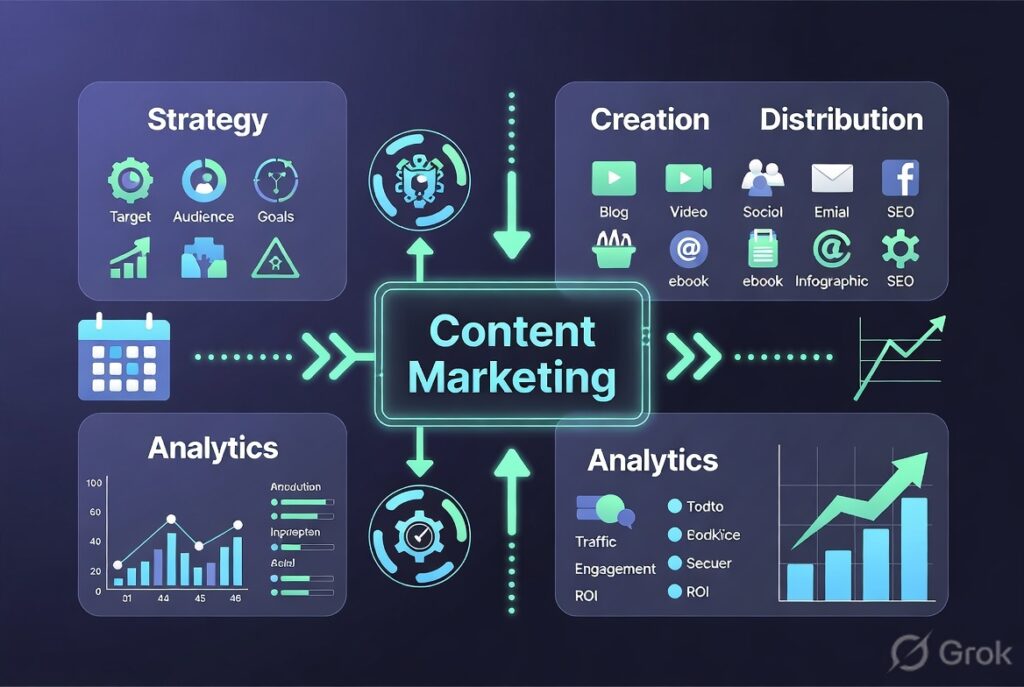
If you want to grow your website organically, attract the right audience, and build long-term trust with potential customers, this Content Marketing Guide is the perfect place to start. While paid advertising can generate immediate traffic, content marketing creates lasting value by helping your audience solve real problems. As a result, your business can earn higher search engine rankings, increase brand authority, and generate qualified leads over time.
Today, search engines prioritize helpful, informative, and people-first content. Moreover, AI-powered search experiences have made quality content more important than ever. Businesses that consistently publish relevant, well-optimized content are more likely to gain visibility across traditional search engines and AI search platforms.
Whether you are a small business owner, marketer, blogger, or entrepreneur, understanding how to create and distribute valuable content is essential for long-term digital success. Throughout this Content Marketing Guide, you’ll learn proven strategies, best practices, content planning techniques, SEO optimization methods, and practical examples that can help you create content that attracts, engages, and converts your audience.
By the end of this guide, you’ll have a clear roadmap for developing a successful content marketing strategy that supports your business goals while improving your website’s authority and organic traffic.
What Is a Content Marketing Guide?
A content marketing guide is a comprehensive resource that explains how to plan, create, publish, promote, and optimize content to attract a clearly defined audience. Instead of directly promoting products or services, content marketing focuses on providing valuable information that educates, informs, entertains, or solves problems.
This customer-first approach helps businesses establish trust before asking potential customers to make a purchase. Consequently, visitors are more likely to engage with your brand, subscribe to your content, and eventually become loyal customers.
Unlike traditional advertising, content marketing continues delivering value long after it is published. A well-written blog post, detailed guide, or educational video can generate traffic, leads, and conversions for months or even years.
What Is Content Marketing?
Content marketing is a strategic marketing approach centered on creating and distributing valuable, relevant, and consistent content to attract and retain a specific audience. Rather than interrupting users with advertisements, content marketing earns their attention by offering useful information.
Content can take many forms, including:
- Blog articles
- How-to guides
- Videos
- Infographics
- Podcasts
- Email newsletters
- Case studies
- Whitepapers
- Checklists
- Webinars
- Social media posts
Each type of content serves a unique purpose within the customer journey. For example, educational blog posts help users discover your website, while case studies build trust among potential buyers. Similarly, email newsletters keep existing customers engaged and informed.
Why Content Marketing Matters?
Consumers today have access to more information than ever before. Before making a purchase, they often research products, compare solutions, read reviews, and seek expert advice. Businesses that provide helpful content during this process are more likely to earn customer trust.
Here are some of the key reasons why content marketing is essential:
Builds Brand Authority
Publishing accurate, well-researched content positions your business as a trusted source of information. Over time, readers begin to view your brand as an industry expert, making them more likely to choose your products or services.
Improves Search Engine Rankings
Search engines reward websites that consistently publish high-quality, relevant content. Every new blog post or resource creates another opportunity to rank for valuable keywords and attract organic traffic.
For example, a digital marketing agency can publish articles about SEO, PPC, content marketing, and local SEO to target multiple search queries and reach different audiences.
Generates Qualified Leads
Educational content attracts people who are actively searching for solutions. Since these visitors already have an interest in your topic, they are more likely to become qualified leads compared to users reached through broad advertising campaigns.
Supports Every Stage of the Customer Journey
Content marketing helps potential customers from awareness to decision-making.
For instance:
- A beginner may discover your blog through a Google search.
- Later, they might read your comparison guide.
- Next, they may download a checklist.
- Finally, they could contact your business for professional services.
Each piece of content moves users one step closer to becoming customers.
Delivers Long-Term Results
Unlike paid advertisements that stop generating traffic when your budget ends, quality content continues attracting visitors over time. A well-optimized article published today may still generate traffic several years later with periodic updates.
How Content Marketing Has Evolved in 2026?
Content marketing has changed significantly over the past decade. Previously, businesses could achieve high rankings simply by publishing keyword-focused articles. Today, search engines evaluate content based on its usefulness, accuracy, experience, and overall value to users.
Several major trends have shaped modern content marketing:
User Experience Comes First
Search engines increasingly prioritize websites that provide clear, helpful, and engaging content. Fast-loading pages, logical navigation, and mobile-friendly designs all contribute to better user experiences and improved rankings.
AI Search Is Changing Content Discovery
AI-powered search tools summarize information and answer user questions directly. To remain competitive, businesses must create comprehensive, trustworthy, and original content that demonstrates expertise and answers search intent thoroughly.
Topical Authority Matters More Than Individual Articles
Instead of publishing random blog posts, successful websites build topical authority by covering related subjects in depth.
For example, if your website focuses on digital marketing, your content should include guides on SEO, keyword research, local SEO, content marketing, technical SEO, PPC, and AI search optimization. Together, these articles signal expertise to search engines.
Search Intent Is More Important Than Keywords Alone
Modern SEO is no longer about repeating keywords excessively. Instead, successful content satisfies the reason behind a user’s search.
For example:
- Someone searching for “What is content marketing?” wants educational information.
- Someone searching for “Content marketing agency” is likely looking for professional services.
Understanding this difference allows you to create content that better meets user expectations.
Why Content Marketing and SEO Work Together?
Content marketing and SEO are complementary strategies. Without SEO, valuable content may struggle to reach its intended audience. Likewise, SEO without high-quality content offers little value to users.
Combining both strategies helps businesses:
- Increase organic traffic.
- Improve keyword rankings.
- Enhance user engagement.
- Build topical authority.
- Earn quality backlinks.
- Strengthen brand credibility.
- Generate consistent leads.
- Improve conversion rates.
For best results, every content marketing strategy should include proper keyword research, optimized headings, internal linking, image optimization, and regular content updates.
Why Every Business Needs a Content Marketing?
A successful online presence is built on more than just having a website. To attract visitors, build trust, and convert prospects into customers, you need a clear strategy for creating valuable content. This is where a content marketing guide becomes essential.
Content marketing is not only for large enterprises. Whether you run a local business, an eCommerce store, a healthcare practice, or a digital marketing agency, publishing helpful content consistently can help you reach your target audience and achieve long-term growth.
Unlike paid advertising, which stops generating traffic when your budget runs out, content marketing continues to deliver value over time. Every blog post, guide, case study, or video becomes a long-term asset that can attract visitors and generate leads for months or even years.
Benefits of Following a Content Marketing
Implementing a structured content marketing strategy offers numerous benefits. Let’s explore the most important ones.
Increase Organic Website Traffic
One of the biggest advantages of content marketing is its ability to attract visitors through search engines. When you publish high-quality content that answers users’ questions, your website has more opportunities to rank for relevant keywords.
For example, if your business offers SEO services, publishing guides about keyword research, on-page SEO, technical SEO, and local SEO allows you to target multiple search queries. As your content library grows, your website gains greater visibility in search results.
Additionally, regularly updating existing articles helps maintain rankings and keeps your content relevant to changing search trends.
Build Trust and Credibility
Modern consumers rarely make purchasing decisions without conducting research first. They compare products, read reviews, and seek expert advice before choosing a solution.
By consistently publishing accurate, informative, and well-researched content, you position your business as a reliable source of information. Over time, readers begin to trust your expertise, making them more likely to choose your products or services.
Trust is especially important in competitive industries such as healthcare, finance, legal services, education, and digital marketing.
Generate High-Quality Leads
A major strength of content marketing is attracting visitors who are actively searching for solutions.
For instance, someone searching for “how to improve website SEO” is already interested in digital marketing. If your article provides valuable insights and addresses their needs, they may explore your services or contact your business for professional assistance.
This makes content marketing one of the most effective methods for generating qualified leads without relying solely on paid advertising.
Improve Brand Awareness
Every piece of content you publish introduces your brand to new audiences.
Even if readers do not become customers immediately, they begin recognizing your business whenever they encounter your articles, videos, or social media posts.
Consistent branding across your content helps establish familiarity, which often influences future purchasing decisions.
Support Every Stage of the Customer Journey
Customers rarely make purchasing decisions instantly. Instead, they move through several stages before becoming buyers.
A well-planned content marketing guide helps you create content for each stage.
Awareness Stage
The audience is identifying a problem.
Examples include:
- What is SEO?
- Why is website traffic decreasing?
- How does content marketing work?
Educational blog posts perform well during this stage.
Consideration Stage
Prospective customers compare available solutions.
Useful content includes:
- Comparison articles
- Product reviews
- Case studies
- Expert guides
These resources help users evaluate their options.
Decision Stage
Potential customers are ready to choose a solution.
Content that supports this stage includes:
- Service pages
- Testimonials
- Success stories
- Pricing guides
- Consultation offers
By providing relevant content throughout the customer journey, you improve conversion opportunities.
Deliver Long-Term Marketing Results
Unlike social media posts that quickly disappear from users’ feeds, evergreen content continues generating traffic over time.
For example, a comprehensive guide about content marketing can remain valuable for several years with periodic updates.
This means your earlier content continues contributing to your business growth while you publish new resources.
The Key Elements of a Successful Content Marketing Guide
Creating content without a strategy often leads to inconsistent results. Instead, successful businesses follow a structured approach that aligns content with audience needs and business objectives.
The following elements form the foundation of every successful content marketing guide.
Understand Your Target Audience
Before creating any content, identify who you want to reach.
Consider questions such as:
- Who is your ideal customer?
- What problems do they face?
- What information are they searching for?
- Which platforms do they use?
- What motivates their purchasing decisions?
Developing buyer personas helps you create content that addresses real challenges instead of making assumptions.
For example, if your audience consists of small business owners, they may prefer practical guides, step-by-step tutorials, and affordable solutions rather than advanced technical discussions.
Define Clear Content Goals
Every piece of content should have a specific objective.
Common goals include:
- Increasing website traffic
- Generating leads
- Improving search rankings
- Building brand authority
- Educating customers
- Increasing email subscribers
- Driving product sales
Having clear goals makes it easier to measure the success of your content marketing efforts.
Perform Keyword Research
Keyword research is one of the most important steps in content marketing.
Instead of guessing what people search for, use keyword research tools to identify topics with strong search demand and achievable competition.
Focus on:
- Primary keywords
- Long-tail keywords
- Question-based keywords
- Semantic keywords
- Related search terms
Targeting keywords naturally helps search engines understand your content while maintaining a positive reading experience.
Create Helpful, High-Quality Content
Publishing large amounts of content is no longer enough.
Search engines reward content that demonstrates:
- Experience
- Expertise
- Authority
- Trustworthiness
Each article should answer users’ questions completely while providing practical advice and actionable insights.
Avoid publishing content simply to increase word count. Instead, focus on delivering genuine value.
Build a Consistent Publishing Schedule
Consistency is more important than publishing frequently for a short period.
Whether you publish one article each week or four articles each month, maintaining a regular schedule helps search engines crawl your website more frequently and encourages readers to return.
A content calendar can help you organize topics, assign deadlines, and maintain consistency.
Optimize Every Piece of Content
Creating great content is only part of the process. Proper optimization ensures search engines can understand and rank your pages.
Each article should include:
- A compelling title
- Optimized meta title
- Meta description
- Clear headings
- Internal links
- Relevant images
- Image alt text
- Short paragraphs
- Readable formatting
- Calls to action
Additionally, optimize content for mobile devices since a significant portion of users browse on smartphones.
Promote Your Content
Publishing content without promotion limits its reach.
After publishing an article, distribute it across multiple channels such as:
- X (formerly Twitter)
- Email newsletters
- Industry communities
- Online forums
Promotion helps attract visitors, increase engagement, and encourage backlinks.
Measure and Improve Performance
Content marketing is an ongoing process. Regularly review performance metrics to identify what is working and where improvements are needed.
Track metrics such as:
- Organic traffic
- Keyword rankings
- Click-through rate (CTR)
- Bounce rate
- Average engagement time
- Conversion rate
- Backlinks
- Leads generated
Use these insights to update existing content, improve underperforming pages, and refine your overall strategy.
Types of Content Marketing: Choosing the Right Format for Your Audience
A successful content marketing guide is not limited to blog posts. While blogs are an excellent way to attract organic traffic, businesses should use multiple content formats to engage audiences at different stages of the buyer’s journey.
Each type of content serves a unique purpose. Some formats increase brand awareness, while others educate prospects, generate leads, or encourage conversions. Therefore, using a mix of content formats helps you reach a wider audience and maximize your marketing efforts.
Let’s explore the most effective types of content marketing and learn when to use each one.
Blog Posts
Blogging remains one of the most effective content marketing strategies because it helps businesses answer customer questions, improve search engine rankings, and establish topical authority.
High-quality blog posts can target informational keywords, attract backlinks, and drive consistent organic traffic over time.
Some popular blog topics include:
- How-to guides
- Beginner tutorials
- Industry news
- Product comparisons
- Case studies
- Expert opinions
- Checklists
- Frequently asked questions
For example, a digital marketing agency can publish articles about SEO, PPC, content marketing, local SEO, and website optimization to attract potential clients searching for these services.
To maximize results, ensure every blog post includes:
- A compelling headline
- Relevant keywords
- Clear headings
- Internal links
- Images with descriptive alt text
- A strong call to action
Videos
Video content has become one of the fastest-growing forms of digital marketing. Many users prefer watching a short tutorial instead of reading a lengthy article.
Videos are particularly effective for:
- Product demonstrations
- Tutorials
- Customer testimonials
- Behind-the-scenes content
- Webinars
- Interviews
- Educational explainers
Additionally, videos increase user engagement and can keep visitors on your website longer, which may contribute to better SEO performance.
Embedding relevant videos within blog posts also enhances the overall user experience.
Infographics
Infographics present complex information in a visually appealing and easy-to-understand format.
They work well for:
- Statistics
- Step-by-step processes
- Timelines
- Comparisons
- Industry trends
- Research findings
Because infographics are highly shareable, they can also attract valuable backlinks from other websites.
Case Studies
Case studies demonstrate how your products or services helped real customers solve specific problems.
They build credibility by providing measurable results.
A strong case study should include:
- The client’s challenge
- Your solution
- Implementation process
- Results achieved
- Customer feedback
Case studies are especially effective during the consideration and decision stages of the buyer’s journey.
eBooks and Comprehensive Guides
Long-form resources allow businesses to explore topics in greater depth.
Examples include:
- Ultimate guides
- Industry reports
- Research papers
- Whitepapers
- Downloadable eBooks
These resources are excellent lead magnets because users are often willing to provide their email addresses in exchange for valuable information.
This content marketing guide itself is an example of long-form pillar content designed to educate readers while improving search visibility.
Email Newsletters
Email marketing remains one of the highest-ROI digital marketing channels.
Regular newsletters help businesses:
- Share new blog posts
- Promote products
- Announce events
- Send educational tips
- Build customer relationships
Unlike social media, email gives businesses direct access to their audience without depending on platform algorithms.
Podcasts
Podcasts continue growing in popularity because they allow audiences to consume content while commuting, exercising, or working.
Podcast topics may include:
- Expert interviews
- Industry discussions
- Business tips
- Customer success stories
- Educational series
Repurposing podcast episodes into blog posts and social media content further extends their value.
Social Media Content
Social media complements your content marketing efforts by increasing reach and engagement.
Popular content formats include:
- Short videos
- Carousel posts
- Industry insights
- Polls
- Infographics
- Customer testimonials
- Live sessions
However, social media should support your website—not replace it. Whenever possible, direct users from social platforms to your website, where they can access your in-depth content.
How to Create a Content Marketing Strategy?
Publishing content without a strategy often leads to inconsistent traffic and poor engagement. Instead, a documented strategy ensures every piece of content supports your business objectives.
Follow these steps to build an effective content marketing strategy.
Step 1: Identify Your Target Audience
Before creating content, understand who your ideal customers are.
Ask yourself:
- Who are they?
- What challenges do they face?
- Which questions do they ask?
- What solutions are they searching for?
- Which platforms do they use most?
Creating detailed buyer personas helps ensure your content addresses genuine customer needs.
For example:
A local business owner may search for:
- “How to improve local SEO”
Whereas an enterprise marketing manager might search for:
- “Advanced content marketing strategy for B2B companies”
Understanding these differences enables you to create more relevant content.
Step 2: Define SMART Goals
Every content marketing campaign should have measurable objectives.
Examples include:
- Increase organic traffic by 30% within six months.
- Generate 100 qualified leads each month.
- Improve keyword rankings for priority topics.
- Increase newsletter subscriptions.
- Enhance brand awareness.
Specific goals make it easier to evaluate the effectiveness of your strategy.
Step 3: Conduct Keyword Research
Keyword research forms the foundation of successful content marketing.
Rather than targeting broad keywords alone, include:
- Long-tail keywords
- Question-based keywords
- Semantic keywords
- Related searches
For example:
Primary keyword:
- Content Marketing Guide
Supporting keywords:
- Content marketing strategy
- Content marketing examples
- Benefits of content marketing
- Content marketing tips
- Content marketing best practices
- Content marketing for beginners
This approach helps your content rank for multiple relevant search queries.
Step 4: Develop a Content Calendar
A content calendar helps maintain consistency and ensures you publish content regularly.
Your calendar should include:
- Content topics
- Target keywords
- Publishing dates
- Assigned writers
- Promotion schedule
- Update reminders
Planning several months of content in advance helps maintain topical relevance and supports your SEO strategy.
Step 5: Create High-Quality Content
Search engines reward content that is original, comprehensive, and valuable.
When writing each article:
- Answer the user’s question completely.
- Use simple language.
- Include examples and actionable advice.
- Support claims with credible sources where appropriate.
- Maintain a logical structure using headings and subheadings.
Avoid writing solely for search engines. Instead, prioritize helping your readers solve their problems.
Step 6: Optimize Content for SEO
SEO optimization ensures search engines understand your content.
Before publishing, check that your article includes:
- Primary keyword in the title
- Keyword within the first paragraph
- Optimized URL
- Meta title
- Meta description
- H2 and H3 headings
- Internal links
- External references where appropriate
- Image alt text
- Mobile-friendly formatting
Additionally, improve readability by using short paragraphs, bullet points, and transition words.
Step 7: Promote Your Content
Publishing is only the beginning.
Increase visibility by sharing content through:
- X (formerly Twitter)
- Email campaigns
- Industry forums
- Online communities
- Business partnerships
Promotion helps generate traffic, social engagement, and backlinks.
Step 8: Analyze and Improve Performance
Content marketing is a continuous process.
Regularly monitor:
- Organic traffic
- Keyword rankings
- User engagement
- Conversion rates
- Bounce rate
- Average time on page
- Backlink growth
Update older content to keep it accurate and relevant. Refreshing existing articles often delivers faster results than creating entirely new content.
Build Topic Clusters Instead of Standalone Articles
One of the most effective SEO strategies in 2026 is building topic clusters. Instead of publishing unrelated blog posts, organize your content around a central pillar page supported by related articles.
For example, this content marketing guide can act as the pillar page, while supporting articles include:
- Keyword Research Guide
- How to Write a Blog Post
- On-Page SEO Guide
- Technical SEO Guide
- Local SEO Guide
- Generative Engine Optimization (GEO) Guide
- SEO Content Writing Tips
- Content Calendar Template
- How to Measure Content Marketing ROI
Linking these articles together helps search engines understand your expertise and improves the user experience.
SEO Best Practices for a Successful Content Marketing Guide
Creating high-quality content is only half the battle. To ensure your content reaches the right audience, it must also be optimized for search engines. A well-optimized content marketing guide combines valuable information with SEO best practices, making it easier for search engines to understand your content and rank it for relevant searches.
Modern SEO is no longer about adding keywords repeatedly. Instead, it focuses on delivering the best possible user experience while providing comprehensive, trustworthy, and relevant information.
Let’s explore the SEO practices that can significantly improve the performance of your content.
Understand Search Intent Before Writing
Every successful piece of content starts with understanding why users are searching for a particular topic.
Search intent generally falls into four categories:
Informational Intent
Users want to learn something.
Examples include:
- What is content marketing?
- How does SEO work?
- What are backlinks?
These searches require educational and in-depth content.
Navigational Intent
Users are looking for a specific website or brand.
Examples include:
- Google Search Console
- Ahrefs login
- AdsnSEO website
These users already know where they want to go.
Commercial Investigation
Users are comparing options before making a purchase.
Examples include:
- Best content marketing tools
- SEMrush vs Ahrefs
- Best digital marketing agencies
Comparison articles and buying guides perform well for these searches.
Transactional Intent
Users are ready to take action.
Examples include:
- Hire an SEO agency
- Buy email marketing software
- Content writing services
Service pages and landing pages are ideal for transactional keywords.
When writing any article, match your content to the user’s intent rather than focusing only on keywords.
Create High-Quality, Helpful Content
Google rewards content that genuinely helps users solve problems.
Every article should:
- Answer the user’s question completely.
- Be easy to read.
- Include practical examples.
- Offer actionable advice.
- Stay updated with current information.
- Cover the topic comprehensively.
Avoid writing content simply to meet a word count. Instead, focus on providing real value.
Ask yourself:
“Would someone leave this page feeling that all of their questions have been answered?”
If the answer is yes, you’re on the right track.
Optimize On-Page SEO
On-page SEO helps search engines understand the structure and relevance of your content.
Every article should include:
Optimized Title
Write a compelling title that naturally includes the primary keyword.
Example:
The Ultimate Content Marketing Guide (2026): Build a Strategy That Drives Traffic, Leads & Sales
SEO-Friendly URL
Keep URLs short and descriptive.
Example:
yourdomain.com/content-marketing-guide
Avoid unnecessary words, dates, or special characters.
Meta Title and Meta Description
Your meta title should encourage users to click while accurately describing the page.
Similarly, the meta description should summarize the article and include the primary keyword naturally.
Use Proper Heading Structure
Organize your content using:
- One H1
- Multiple H2 headings
- Supporting H3 and H4 headings where necessary
A logical structure improves readability for both users and search engines.
Write Short Paragraphs
Large blocks of text discourage readers.
Instead:
- Keep paragraphs between two and four sentences.
- Use bullet points where appropriate.
- Add numbered lists for step-by-step processes.
- Include transition words to improve flow.
This makes your content easier to scan and understand.
Optimize Images
Images improve engagement and make lengthy articles easier to read.
However, they should also be optimized.
Best practices include:
- Compress images to improve page speed.
- Use descriptive file names.
- Add keyword-relevant alt text.
- Choose modern image formats such as WebP where possible.
- Ensure images are mobile-friendly.
For example:
Image File Name
content-marketing-guide-strategy.webp
Alt Text
Content Marketing Guide showing a complete content strategy workflow
Build Strong Internal Links
Internal linking is one of the most overlooked SEO techniques.
It helps:
- Improve user navigation.
- Increase page authority.
- Encourage visitors to explore more content.
- Help search engines discover new pages.
For example, within this guide, you can naturally link to:
- Keyword Research Guide
- How to Write a Blog Post
- On-Page SEO Guide
- Technical SEO Guide
- Generative Engine Optimization (GEO) Guide
- Local SEO Guide
- SEO Content Writing Tips
Avoid adding internal links randomly. Instead, ensure each link provides additional value to readers.
Use External Links Wisely
External links help support your content by referencing authoritative sources.
Consider linking to trusted organizations, research reports, or official documentation when appropriate.
Examples include:
- Google Search Central
- Google Analytics Help Center
- HubSpot research
- Content Marketing Institute
Use external links only when they improve the reader’s understanding.
Optimize for Featured Snippets
Featured snippets appear above traditional search results and often receive high click-through rates.
To improve your chances:
- Answer questions directly.
- Use numbered lists.
- Include bullet points.
- Add concise definitions.
- Use descriptive headings.
For example:
What Is Content Marketing?
Content marketing is a strategic approach to creating and distributing valuable content that attracts, engages, and retains a clearly defined audience.
This type of concise answer is ideal for featured snippets.
Improve Core Web Vitals
User experience directly impacts SEO.
Focus on:
- Fast page loading
- Mobile responsiveness
- Stable page layout
- Easy navigation
- Readable fonts
- Optimized images
Visitors are more likely to stay on websites that load quickly and provide a smooth browsing experience.
Update Existing Content Regularly
SEO is not a one-time task.
Instead of publishing new content continuously, review older articles every few months.
Update:
- Statistics
- Examples
- Screenshots
- Broken links
- Keywords
- New industry developments
Regular updates help maintain rankings and improve user trust.
Common Content Marketing Mistakes to Avoid
Even experienced marketers make mistakes that limit their results.
Avoid these common issues.
Publishing Without a Strategy
Random blog posts rarely build authority.
Instead, create a documented content plan aligned with your business goals.
Ignoring Keyword Research
Writing content without understanding what your audience searches for often results in poor visibility.
Always conduct keyword research before creating content.
Keyword Stuffing
Repeating the same keyword unnaturally harms readability and may negatively impact SEO.
Instead, use:
- Related keywords
- Synonyms
- Natural language
- Semantic terms
Your Content Marketing Guide should always read naturally.
Thin Content
Short articles that fail to answer user questions rarely perform well.
Cover topics comprehensively while avoiding unnecessary repetition.
Weak Headlines
Your title determines whether users click your article.
Write headlines that are:
- Clear
- Specific
- Benefit-driven
- Relevant
Ignoring Mobile Users
Most users browse on smartphones.
Ensure your content is:
- Mobile-friendly
- Easy to scroll
- Fast loading
- Properly formatted
Forgetting Calls to Action
Many businesses publish valuable content but fail to tell readers what to do next.
Every article should encourage users to:
- Contact your business
- Download a resource
- Subscribe to a newsletter
- Read another guide
- Request a consultation
Best Tools for Content Marketing
Using the right tools improves productivity and helps create better content.
Here are some essential tools every marketer should consider.
| Purpose | Recommended Tool |
| Keyword Research | Google Keyword Planner, Ahrefs, SEMrush |
| SEO Analysis | Google Search Console |
| Website Analytics | Google Analytics 4 |
| Content Writing | ChatGPT, Grammarly |
| Graphic Design | Canva |
| Project Management | Trello, Notion |
| Content Optimization | Surfer SEO |
| Page Speed Testing | Google PageSpeed Insights |
These tools can help you streamline your workflow, identify optimization opportunities, and measure the effectiveness of your content marketing efforts.
Content Marketing Trends in 2026
The digital marketing landscape continues to evolve rapidly. Search engines are becoming smarter, AI-powered search experiences are changing how users discover information, and customer expectations are higher than ever. Therefore, businesses must adapt their content strategies to remain competitive.
A modern Content Marketing Guide should not only focus on creating quality content but also embrace emerging trends that improve visibility, engagement, and conversions.
Let’s explore the most important content marketing trends shaping 2026.
AI-Assisted Content Creation
Artificial Intelligence has become a valuable assistant for marketers. However, successful businesses use AI to improve efficiency—not to replace human expertise.
AI can help with:
- Brainstorming blog topics
- Creating content outlines
- Keyword research
- Writing meta descriptions
- Content optimization
- Grammar and readability improvements
Nevertheless, every article should be reviewed, edited, and enhanced by a human writer. Original insights, real-world examples, and industry expertise make content more trustworthy and valuable.
Generative Engine Optimization (GEO)
Traditional SEO focuses on ranking in search engine results pages. In contrast, Generative Engine Optimization (GEO) helps your content appear in AI-generated search responses.
To optimize for GEO:
- Answer questions directly.
- Provide comprehensive explanations.
- Use clear headings.
- Include factual, accurate information.
- Build topical authority through related content.
- Keep content updated regularly.
Businesses that optimize for both SEO and GEO will have greater visibility across traditional search engines and AI-powered platforms.
Topical Authority Becomes More Important
Search engines increasingly reward websites that demonstrate expertise across an entire subject rather than publishing isolated articles.
For example, instead of writing only one article about content marketing, build a complete content hub that includes:
- Content Marketing Guide
- Keyword Research Guide
- How to Write a Blog Post
- SEO Content Writing Tips
- On-Page SEO Guide
- Technical SEO Guide
- Local SEO Guide
- Link Building Guide
This topic cluster approach helps establish authority and improves your chances of ranking for competitive keywords.
Personalized Content
Modern audiences expect content tailored to their interests and needs.
Businesses can personalize content by:
- Recommending related articles
- Segmenting email campaigns
- Creating industry-specific guides
- Addressing different audience personas
Personalization improves user engagement and encourages visitors to spend more time on your website.
Short-Form Video Content
Short educational videos continue to grow across platforms like YouTube Shorts, Instagram Reels, and LinkedIn.
Repurpose your blog content into:
- Quick SEO tips
- Industry updates
- Infographics
- Video summaries
- Expert advice
This extends the reach of your content while driving traffic back to your website.
First-Party Data Marketing
As privacy regulations evolve and third-party cookies become less reliable, businesses are increasingly relying on first-party data.
Examples include:
- Email subscribers
- Customer surveys
- Website analytics
- CRM data
- Downloadable resources
Collecting data ethically helps businesses better understand customer needs while maintaining trust.
Content Marketing Examples
Understanding theory is helpful, but practical examples demonstrate how businesses can apply a content marketing guide effectively.
Example 1: Local Business
A local plumbing company publishes articles such as:
- How to Fix a Leaking Tap
- Signs You Need Pipe Replacement
- Common Plumbing Problems During Winter
These articles attract homeowners searching for solutions, increasing local visibility and generating service inquiries.
Example 2: Digital Marketing Agency
A digital marketing agency develops a comprehensive resource center featuring:
- SEO guides
- PPC tutorials
- Content marketing tips
- Social media strategies
- Website optimization techniques
By targeting informational keywords, the agency establishes expertise and attracts businesses looking for marketing services.
Example 3: Healthcare Website
A healthcare website publishes educational articles covering:
- Electronic Medical Records (EMR)
- Electronic Health Records (EHR)
- Medical billing
- Healthcare compliance
- Patient engagement
These resources help healthcare professionals stay informed while improving the website’s search visibility.
Example 4: E-commerce Business
An online furniture retailer creates buying guides such as:
- How to Choose the Right Office Chair
- Best Ergonomic Desks
- Home Office Setup Ideas
Educational content assists customers during the buying process while increasing product page traffic.
Example 5: SaaS Company
A software company produces:
- Product tutorials
- Feature comparison guides
- Customer success stories
- Industry reports
- Video demonstrations
This content supports users throughout the customer journey and improves customer retention.
How to Measure Content Marketing Success?
Creating valuable content is only the first step. Measuring performance helps you understand what works and where improvements are needed.
Track the following metrics regularly.
Organic Traffic
Monitor the number of visitors arriving through search engines.
Increasing organic traffic generally indicates that your content is ranking well and attracting the right audience.
Keyword Rankings
Track how your target keywords perform over time.
Improving rankings often lead to greater visibility and higher website traffic.
Click-Through Rate (CTR)
CTR measures how many users click your page after seeing it in search results.
A higher CTR usually indicates compelling titles and meta descriptions.
Average Engagement Time
The longer visitors stay on your pages, the more likely they find your content valuable.
Improve engagement by:
- Using clear formatting
- Adding visuals
- Including examples
- Writing naturally
Bounce Rate
A high bounce rate may indicate that users are not finding the information they expected.
Improve retention through:
- Better internal linking
- Clear navigation
- Faster page speed
- Comprehensive content
Lead Generation
Measure how many readers:
- Contact your business
- Subscribe to newsletters
- Download resources
- Request consultations
Ultimately, content marketing should contribute to business growth—not just website traffic.
Conversion Rate
Traffic alone does not guarantee success.
Track how many visitors become customers after engaging with your content.
Even small improvements in conversion rates can significantly increase revenue.
Frequently Asked Questions
1. What is a Content Marketing Guide?
A Content Marketing Guide is a comprehensive resource that explains how to plan, create, publish, optimize, and promote valuable content to attract, engage, and convert your target audience. It helps businesses build authority, improve search visibility, and generate long-term results.
2. Why is content marketing important?
Content marketing helps businesses attract organic traffic, establish trust, educate potential customers, improve SEO performance, and generate qualified leads. Unlike paid advertising, high-quality content continues to deliver value long after it is published.
3. How often should I publish content?
Consistency is more important than frequency. Publishing one high-quality article each week is generally more effective than posting multiple low-quality articles. Create a content calendar and maintain a schedule you can sustain.
4. How long does content marketing take to show results?
Content marketing is a long-term strategy. While some improvements may appear within a few months, significant growth in organic traffic, rankings, and lead generation typically takes six to twelve months of consistent effort.
5. What are the best types of content for SEO?
Some of the most effective content formats include:
- Ultimate guides
- How-to articles
- Tutorials
- Case studies
- Product comparisons
- Checklists
- Industry reports
- Frequently asked questions
Publishing a variety of content formats helps attract different audiences and supports multiple search intents.
6. Is content marketing suitable for small businesses?
Yes. Content marketing is one of the most cost-effective digital marketing strategies for small businesses. By consistently publishing valuable content, small businesses can compete with larger brands and build lasting relationships with their audience.
7. What is the difference between content marketing and SEO?
Content marketing focuses on creating valuable content for users, while SEO ensures that content is discoverable in search engines. Together, they help businesses attract targeted traffic, improve visibility, and increase conversions.
Conclusion
A successful Content Marketing Guide is much more than a collection of blog posts. It is a strategic framework for creating valuable content that educates your audience, strengthens your brand, and drives sustainable business growth.
Throughout this guide, you’ve learned how to understand your audience, perform keyword research, develop a content strategy, optimize for SEO, avoid common mistakes, leverage modern marketing trends, and measure performance effectively.
The key to long-term success lies in consistency. Publish helpful, well-structured, and user-focused content regularly, update existing articles, and organize your website using topic clusters. Over time, these efforts will improve your search rankings, build topical authority, and generate a steady flow of qualified leads.
Remember, content marketing is not about creating more content—it’s about creating the right content that genuinely helps your audience.
Ready to Grow Your Business with Content Marketing?
Creating high-quality content consistently takes time, expertise, and a well-planned strategy. If you want to improve your search rankings, increase organic traffic, and generate more qualified leads, AdsnSEO Digital Marketing is here to help.
Our team specializes in:
- Content Marketing Strategy
- SEO Content Writing
- Keyword Research
- On-Page SEO
- Technical SEO
- Local SEO
- Topic Cluster Planning
- Generative Engine Optimization (GEO)
- Website SEO Audits
- Performance Tracking and Optimization
Whether you’re launching a new website or expanding your existing content library, we’ll develop a tailored content marketing strategy that aligns with your business goals and delivers measurable results.
Contact AdsnSEO Digital Marketing today and let us help you create content that ranks higher, engages your audience, and drives sustainable business growth.