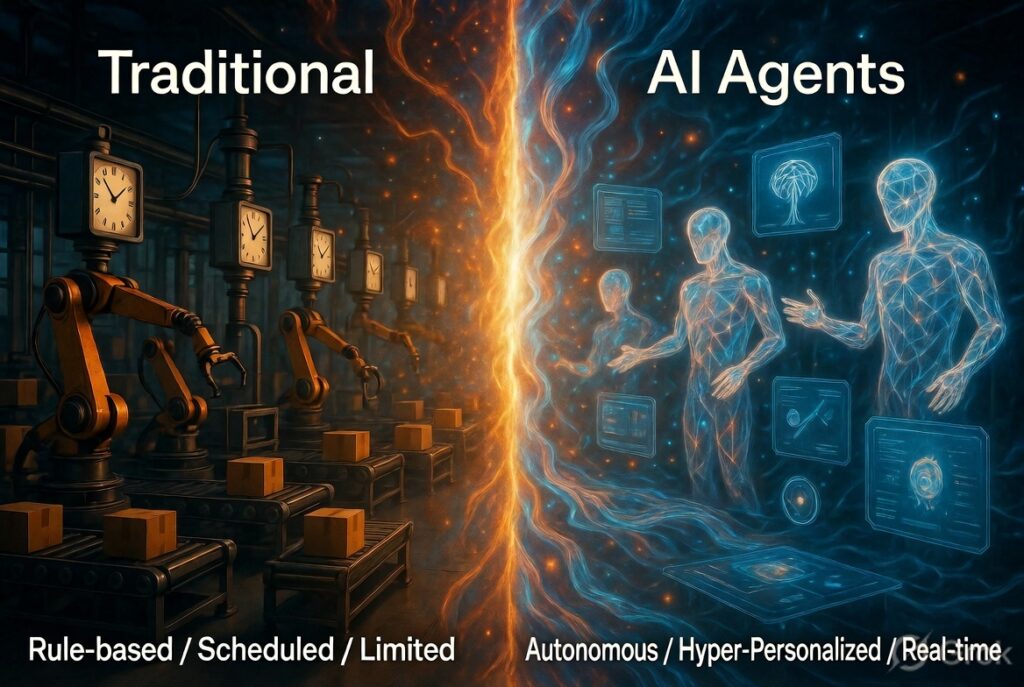
Marketing technology has evolved rapidly over the last decade. Businesses no longer rely only on email campaigns or scheduled social media posts to reach their audience. Instead, they are embracing intelligent systems that can analyze data, make decisions, and optimize campaigns in real time. This shift has introduced a new question for marketers: AI Agents vs Traditional Marketing Automation— which approach delivers better results?
Traditional marketing automation has been a reliable solution for years. It helps businesses automate repetitive tasks such as sending emails, nurturing leads, scheduling social media posts, and managing customer journeys. While these tools save time and improve efficiency, they often depend on predefined rules and workflows.
AI agents, however, take automation a step further. They can learn from data, adapt to changing customer behavior, generate personalized content, and make intelligent decisions with minimal human intervention. Instead of simply following instructions, AI agents continuously improve their performance based on real-time insights.
As artificial intelligence becomes more accessible, businesses of all sizes are exploring how AI can enhance their marketing efforts. However, many marketers still wonder whether they should replace traditional automation entirely or combine it with AI-powered solutions.
What Are AI Agents in Marketing?
Before comparing AI Agents vs Traditional Marketing Automation, it is important to understand what AI agents actually are.
An AI agent is an intelligent software system that can perform tasks, make decisions, and adapt to new information without requiring constant human guidance. Unlike conventional automation tools, AI agents analyze data, identify patterns, learn from previous interactions, and continuously improve their performance.
Think of an AI agent as a digital marketing assistant that not only completes tasks but also understands context and recommends better actions over time. For example, instead of simply sending an email at a scheduled time, an AI agent can:
- Analyze customer behavior.
- Predict the best time to send an email.
- Personalize the subject line.
- Recommend products based on browsing history.
- Adjust future campaigns according to customer responses.
As a result, marketers can create highly personalized experiences while reducing manual effort.
How AI Agents Work?
AI agents rely on several advanced technologies that work together to improve marketing performance.
Data Collection
AI agents gather information from multiple sources, including websites, CRM systems, email campaigns, social media platforms, and customer interactions.
Data Analysis
Once the data is collected, the AI identifies patterns, customer preferences, purchasing behavior, and engagement trends.
Decision Making
Unlike rule-based automation, AI agents evaluate different possibilities before selecting the most effective action.
For example, an AI agent can determine:
- Which customer should receive a follow-up email.
- Which advertisement should receive a higher budget.
- Which audience segment is most likely to convert.
Continuous Learning
One of the biggest advantages of AI agents is their ability to improve over time.
Every interaction provides new data that helps the AI make smarter recommendations in future campaigns. This continuous learning enables businesses to achieve better marketing performance without manually updating every workflow.
Key Features of AI Agents
AI agents are transforming digital marketing because they combine automation with intelligence. Here are some of their most valuable capabilities.
Real-Time Decision Making
Traditional automation follows predefined rules. AI agents, however, evaluate situations in real time and choose the most suitable action based on current data.
For example, if customer engagement suddenly increases after a specific campaign, the AI agent can automatically allocate additional advertising budget to maximize results.
Personalized Customer Experiences
Today’s customers expect personalized interactions.
AI agents analyze customer behavior, purchase history, demographics, and browsing activity to deliver highly relevant content.
Examples include:
- Personalized email campaigns
- Product recommendations
- Customized landing pages
- Dynamic website content
- Individual customer offers
This level of personalization often leads to higher engagement and better conversion rates.
Predictive Analytics
AI agents don’t simply report past performance.
Instead, they forecast future outcomes by analyzing historical data and current trends. This allows marketers to:
- Predict customer churn
- Forecast campaign performance
- Estimate future sales
- Identify high-value leads
- Optimize marketing budgets
Predictive insights help businesses make proactive decisions instead of reacting after problems occur.
Content Generation
Modern AI agents can create various types of marketing content, including:
- Blog outlines
- Social media captions
- Email copy
- Product descriptions
- Ad headlines
- SEO meta descriptions
Although human review remains important, AI significantly speeds up the content creation process while maintaining consistency.
Campaign Optimization
Marketing campaigns often require continuous adjustments. AI agents automatically monitor campaign performance and optimize variables such as:
- Bid strategies
- Audience targeting
- Content recommendations
- Email timing
- Budget allocation
Consequently, marketers spend less time on manual optimization and more time developing strategic initiatives.
What Is Traditional Marketing Automation?
To fully understand AI Agents vs Traditional Marketing Automation, it’s equally important to understand the capabilities of traditional marketing automation.
Traditional marketing automation refers to software that automates repetitive marketing tasks based on predefined rules and workflows. These systems execute tasks exactly as configured by the marketer without independently learning or adapting.
For years, businesses have relied on marketing automation platforms to improve efficiency, nurture leads, and maintain consistent communication with customers. For example, a business might configure the following workflow:
- A visitor downloads an eBook.
- The system automatically sends a thank-you email.
- Three days later, it sends a product guide.
- After one week, it sends a promotional offer.
- If the customer makes a purchase, the workflow stops automatically.
This rule-based automation saves time and ensures every lead follows a structured customer journey.
However, if customer behavior changes unexpectedly, the workflow remains unchanged unless a marketer manually updates the rules.
AI Agents vs Traditional Marketing Automation: Key Differences
Although both aim to improve marketing efficiency, they operate very differently. Traditional marketing automation follows predefined rules created by marketers. AI agents, on the other hand, analyze data, learn from customer interactions, and make intelligent decisions without requiring constant manual updates.
The following comparison highlights the most important differences.
| Feature | AI Agents | Traditional Marketing Automation |
| Decision-making | Intelligent and data-driven | Rule-based |
| Learning capability | Continuously learns and improves | Does not learn automatically |
| Personalization | Dynamic and real-time | Limited to predefined rules |
| Customer interactions | Context-aware and adaptive | Predefined responses |
| Content creation | AI-generated and personalized | Mostly manual |
| Campaign optimization | Automatic and continuous | Manual optimization |
| Data analysis | Predictive and real-time | Historical reporting |
| Flexibility | Highly adaptable | Limited by workflows |
| Human involvement | Low to moderate | Moderate to high |
| Best for | Complex marketing strategies | Repetitive marketing tasks |
While both solutions have their place, AI agents provide greater flexibility and intelligence, especially for businesses handling large amounts of customer data.
AI Agents vs Traditional Marketing Automation: Decision-Making Capability
One of the biggest differences between AI Agents vs Traditional Marketing Automation is how decisions are made.
Traditional marketing automation depends entirely on workflows created by marketers. Every action follows an “if this, then that” approach. For example:
- If a customer subscribes to a newsletter, send Email A.
- If the customer opens the email, send Email B.
- If the customer clicks the link, assign the lead to sales.
These workflows work well. However, they cannot adjust unless someone manually changes the rules. AI agents operate differently. Instead of following fixed instructions, they evaluate customer behavior continuously.
Imagine a customer who:
- Visits your pricing page several times.
- Watches product videos.
- Downloads a buying guide.
- Returns to your website multiple times.
An AI agent recognizes these signals and may decide to:
- Send a personalized offer.
- Notify the sales team immediately.
- Recommend a product demonstration.
- Trigger a chatbot conversation.
- Display customized landing pages.
All of these decisions happen automatically based on customer intent rather than predefined rules. This ability to make intelligent decisions makes AI agents far more responsive in fast-changing marketing environments.
AI Agents vs Traditional Marketing Automation: Learning and Adaptability
Another major difference is the ability to learn. Traditional marketing automation systems remain static until someone updates the workflows. If customer preferences change, marketers must manually modify:
- Email sequences
- Customer journeys
- Lead scoring
- Campaign rules
- Segmentation
Without regular updates, automation becomes outdated. AI agents solve this problem by learning from every interaction. For example, suppose an email campaign consistently performs better when sent at 8 PM rather than 10 AM.
Instead of waiting for a marketer to notice the trend, an AI agent can automatically recommend or implement the better sending time.
Similarly, AI agents learn:
- Which headlines attract more clicks.
- Which audience converts faster.
- Which products sell together.
- Which campaigns perform poorly.
- Which marketing channels generate higher ROI.
As more data becomes available, the AI becomes smarter. This continuous improvement helps marketers stay ahead of changing customer behavior.
AI Agents vs Traditional Marketing Automation: Personalization
Customers no longer respond well to generic marketing messages. They expect personalized experiences across every touchpoint. This is where AI Agents vs Traditional Marketing Automation becomes especially interesting.
Traditional marketing automation can personalize messages using predefined customer information such as:
- First name
- Location
- Purchase history
- Customer segment
Although helpful, this level of personalization remains limited. AI agents analyze much richer customer signals, including:
- Browsing behavior
- Purchase intent
- Device usage
- Time spent on pages
- Previous interactions
- Engagement history
- Search patterns
Using this information, AI agents create highly personalized experiences. For example, instead of sending the same email to every customer, AI agents can:
- Recommend different products.
- Generate personalized email content.
- Adjust pricing offers.
- Display customized website banners.
- Suggest relevant blog articles.
As a result, customers receive information that better matches their interests, increasing engagement and conversions.
AI Agents vs Traditional Marketing Automation: Customer Engagement
Customer engagement has become one of the most important marketing metrics. Businesses need to communicate with customers at the right time using the right message. Traditional marketing automation usually follows scheduled communication. For example:
- Welcome email after registration.
- Reminder email after three days.
- Promotional email every Friday.
While effective, these communications do not consider changing customer behavior. AI agents provide a much more dynamic approach. They monitor customer activity continuously. Suppose a visitor spends ten minutes comparing pricing plans. An AI agent may immediately:
- Launch a live chat.
- Offer a limited-time discount.
- Recommend a consultation.
- Share customer testimonials.
- Display frequently asked questions.
These actions occur because the AI understands customer intent rather than simply following a calendar. Consequently, businesses create more meaningful customer experiences.
AI Agents vs Traditional Marketing Automation: Content Creation
Content marketing requires consistent production of blogs, emails, social media posts, landing pages, and advertisements. Traditional marketing automation cannot create content. Instead, marketers write everything manually before uploading it into automation software. AI agents change this process significantly. Modern AI agents assist marketers by generating:
- Blog outlines
- Email campaigns
- Social media captions
- Product descriptions
- Meta titles
- Meta descriptions
- Ad copy
- Landing page suggestions
More importantly, AI agents can tailor content to different audience segments. For example:
A software company targeting startups may receive completely different email copy than enterprise customers, even when promoting the same product. Human editing is still important to ensure accuracy, maintain brand voice, and add expertise. However, AI agents dramatically reduce the time required to produce high-quality marketing content.
AI Agents vs Traditional Marketing Automation: Campaign Optimization
Running successful marketing campaigns requires constant monitoring. Traditional marketing automation collects campaign data but leaves optimization to marketers. A marketing manager typically reviews reports and decides whether to:
- Increase ad budgets.
- Pause underperforming campaigns.
- Adjust targeting.
- Change email subject lines.
- Rewrite ad copy.
This process takes time and often delays improvements. AI agents optimize campaigns continuously. They can automatically:
- Adjust advertising bids.
- Reallocate campaign budgets.
- Recommend new audience segments.
- Identify declining performance.
- Suggest better-performing creatives.
- Optimize email send times.
Because these adjustments happen much faster, businesses can improve campaign performance while reducing manual effort.
Benefits of AI Agents vs Traditional Marketing Automation
When comparing AI Agents vs Traditional Marketing Automation, it is important to recognize that both solutions offer unique advantages. The right choice depends on your business goals, marketing budget, and the complexity of your campaigns.
Let’s explore the strengths of each approach.
Benefits of AI Agents
AI agents are transforming digital marketing by combining automation with intelligence. They do much more than execute tasks—they analyze, learn, and optimize continuously.
1. Smarter Decision-Making
Unlike rule-based systems, AI agents evaluate customer behavior before taking action. For example, if a customer repeatedly visits your pricing page, an AI agent can:
- Recommend a product demo
- Notify the sales team
- Trigger a personalized email
- Display a special offer
This helps businesses respond to customer intent in real time instead of relying on fixed workflows.
2. Advanced Personalization
Personalization is no longer optional. Customers expect brands to understand their preferences. AI agents analyze multiple data points, including:
- Browsing history
- Purchase behavior
- Previous interactions
- Device usage
- Location
- Customer interests
Using these insights, they deliver highly personalized experiences that improve engagement and conversion rates. For example, an eCommerce business can recommend different products to two customers based on their browsing history, even if both visit the same product page.
3. Continuous Learning
One of the biggest advantages in AI Agents vs Traditional Marketing Automation is continuous learning. Traditional automation remains unchanged until marketers update workflows. AI agents improve automatically by learning from:
- Campaign performance
- Customer feedback
- Website interactions
- Email engagement
- Sales conversions
As a result, marketing campaigns become more effective over time.
4. Better Campaign Performance
AI agents monitor campaigns around the clock. Instead of waiting for weekly reports, they identify opportunities immediately. They can automatically:
- Optimize bidding strategies
- Improve audience targeting
- Recommend better-performing content
- Reduce wasted advertising spend
- Predict campaign outcomes
This proactive approach helps marketers maximize return on investment (ROI).
5. Increased Productivity
Marketing teams spend countless hours on repetitive tasks. AI agents reduce manual work by assisting with:
- Content creation
- Customer segmentation
- Lead qualification
- Campaign monitoring
- Performance reporting
- Email optimization
This allows marketers to focus on strategy, creativity, and business growth.
Benefits of Traditional Marketing Automation
Although AI is gaining popularity, traditional marketing automation remains an essential tool for many businesses.It offers several advantages, especially for organizations with straightforward marketing needs.
1. Easy to Implement
Most marketing automation platforms provide user-friendly workflow builders. Businesses can quickly automate tasks such as:
- Welcome emails
- Newsletter campaigns
- Lead nurturing
- Appointment reminders
- Customer follow-ups
This makes implementation relatively simple.
2. Predictable Workflows
Traditional automation follows predefined rules. Every customer receives the same sequence of actions based on specific triggers. For businesses that require consistency and compliance, this predictability is a significant advantage.
3. Lower Initial Cost
Compared to AI-powered platforms, many traditional marketing automation solutions have lower subscription costs. Small businesses with limited budgets often begin with rule-based automation before adopting advanced AI capabilities.
4. Proven Reliability
Marketing automation has been used successfully for many years. Businesses trust these systems because they provide stable and predictable performance. When campaigns follow standard customer journeys, traditional automation continues to deliver excellent results.
5. Greater Human Control
Some organizations prefer complete control over every marketing action. Traditional automation allows marketers to define every workflow manually. This reduces unexpected changes and ensures campaigns follow company guidelines.
Limitations of AI Agents
Despite their advantages, AI agents are not perfect. Businesses should understand these limitations before implementing AI-powered marketing.
Higher Initial Investment
Advanced AI platforms often require a larger investment than traditional automation software. Costs may include:
- Software subscriptions
- AI integrations
- Employee training
- Data preparation
However, many businesses recover these costs through improved efficiency and higher conversion rates.
Dependence on Quality Data
AI agents rely heavily on accurate data. If customer data is incomplete or outdated, AI recommendations may become less reliable. Therefore, maintaining clean and organized data is essential for successful AI implementation.
Human Oversight Is Still Necessary
Although AI agents automate many tasks, they cannot replace human creativity, strategic thinking, or ethical decision-making. Marketing professionals should regularly review AI-generated content and recommendations to ensure they align with brand voice and business objectives.
Limitations of Traditional Marketing Automation
Traditional automation also has several challenges that businesses should consider.
Limited Flexibility
Rule-based workflows cannot adapt automatically to changing customer behavior. Whenever marketing strategies change, someone must manually update the workflows. This process can become time-consuming as campaigns grow more complex.
Minimal Learning Capability
Traditional automation software does not learn from campaign performance. Even if one email consistently performs better than another, the system will continue following the original workflow unless a marketer intervenes.
Basic Personalization
Most automation platforms personalize messages using simple customer information such as:
- First name
- Company name
- Location
While useful, this level of personalization is far less sophisticated than AI-driven experiences.
More Manual Work
Marketing teams remain responsible for:
- Creating workflows
- Updating campaigns
- Monitoring reports
- Testing improvements
- Optimizing performance
As businesses scale, managing these manual tasks becomes increasingly difficult.
AI Agents vs Traditional Marketing Automation: Which Is Better for Your Business?
There is no universal answer in the debate over AI Agents vs Traditional Marketing Automation. The best choice depends on your business size, goals, budget, and marketing maturity.
Choose AI Agents If Your Business:
- Handles large amounts of customer data.
- Wants advanced personalization.
- Runs multiple marketing campaigns.
- Needs predictive insights.
- Focuses on improving ROI.
- Wants to automate decision-making.
- Is ready to invest in AI technology.
AI agents are particularly valuable for growing businesses and enterprises that need scalable, intelligent marketing solutions.
Choose Traditional Marketing Automation If Your Business:
- Has a limited marketing budget.
- Runs simple email campaigns.
- Needs basic workflow automation.
- Prefers full control over every process.
- Has a small customer database.
- Is just beginning its digital marketing journey.
Traditional automation remains a practical and cost-effective choice for startups and small businesses with straightforward marketing requirements.
The Best Strategy: Combine Both Technologies
Instead of choosing one over the other, many businesses achieve the best results by integrating AI agents with traditional marketing automation.
For example:
- Use traditional automation to manage routine workflows such as welcome emails, appointment reminders, and lead nurturing.
- Use AI agents to optimize campaigns, personalize customer experiences, generate content ideas, predict customer behavior, and analyze performance.
This hybrid approach combines the reliability of traditional automation with the intelligence and adaptability of AI, helping businesses create more effective and efficient marketing strategies.
The Future of AI Agents vs Traditional Marketing Automation
Artificial intelligence is changing the way businesses plan, execute, and measure marketing campaigns. As AI technology continues to advance, the discussion around AI Agents vs Traditional Marketing Automation will become even more important.
Traditional marketing automation will not disappear overnight. Many businesses have invested heavily in automation platforms, and these tools remain effective for handling repetitive, rule-based tasks. However, customer expectations are evolving. People now expect personalized experiences, instant responses, and relevant recommendations across every digital channel.
This is where AI agents have a clear advantage. Future AI agents will not simply automate marketing tasks. They will act as intelligent marketing partners by:
- Planning multi-channel campaigns.
- Predicting customer behavior before it happens.
- Creating personalized marketing content.
- Optimizing advertising budgets automatically.
- Identifying high-value leads.
- Recommending strategic improvements.
- Delivering real-time campaign insights.
Rather than replacing marketers, AI agents will enhance their capabilities. Marketing professionals will spend less time on repetitive work and more time developing creative strategies, strengthening customer relationships, and driving business growth.
The future of marketing is likely to combine human expertise with AI-powered intelligence, allowing businesses to deliver better customer experiences while improving efficiency.
Can AI Agents and Traditional Marketing Automation Work Together?
Absolutely.
Many organizations are already combining both technologies to create a smarter marketing ecosystem. For example, a business can use traditional marketing automation to:
- Send welcome emails.
- Deliver newsletters.
- Manage lead nurturing campaigns.
- Schedule social media posts.
- Trigger follow-up emails after purchases.
At the same time, AI agents can:
- Recommend the best email subject lines.
- Personalize content for different audience segments.
- Predict which leads are most likely to convert.
- Analyze campaign performance in real time.
- Suggest budget adjustments.
- Generate content ideas.
- Optimize customer journeys.
This combination allows businesses to maintain reliable automation while benefiting from AI-driven intelligence and adaptability.
Best Practices for Implementing AI Agents in Marketing
If your business is planning to adopt AI agents, following these best practices can help maximize success.
Start with Clear Marketing Goals
Before implementing AI, identify the problems you want to solve.
Examples include:
- Increasing lead generation
- Improving email open rates
- Boosting conversion rates
- Enhancing customer engagement
- Reducing manual marketing tasks
Clear objectives make it easier to measure the effectiveness of AI agents.
Maintain High-Quality Data
AI agents rely on accurate and up-to-date data.
Regularly review your:
- CRM records
- Customer profiles
- Website analytics
- Email lists
- Sales data
Clean data improves AI recommendations and campaign performance.
Keep Human Oversight
AI can generate valuable insights, but human expertise remains essential. Always review:
- AI-generated content
- Marketing strategies
- Customer communications
- Campaign recommendations
Human marketers provide creativity, emotional intelligence, and ethical judgment that AI cannot fully replicate.
Monitor Performance Regularly
Even intelligent systems require ongoing evaluation. Track key performance indicators (KPIs) such as:
- Conversion rate
- Click-through rate (CTR)
- Customer acquisition cost (CAC)
- Return on investment (ROI)
- Customer lifetime value (CLV)
- Engagement rate
Regular monitoring helps ensure that AI-driven campaigns continue delivering value.
Frequently Asked Questions
1. What is the main difference between AI Agents vs Traditional Marketing Automation?
The biggest difference is intelligence. Traditional marketing automation follows predefined rules and workflows, while AI agents analyze data, learn from customer behavior, and make intelligent decisions that improve over time.
2. Can AI agents replace traditional marketing automation?
Not completely. AI agents are excellent for personalization, predictive analytics, and decision-making. However, traditional marketing automation remains valuable for routine tasks such as email sequences, lead nurturing, and workflow management.
Many businesses achieve better results by combining both technologies.
3. Are AI agents suitable for small businesses?
Yes. Many AI-powered marketing tools now offer affordable plans designed for startups and small businesses. Even small teams can use AI agents for content creation, customer support, email optimization, and campaign analysis.
4. Do AI agents require technical expertise?
Not always. Modern AI marketing platforms are designed with user-friendly interfaces, making them accessible to marketers without advanced technical skills. However, understanding marketing strategy and data analysis remains beneficial.
5. Which industries benefit most from AI agents?
Almost every industry can benefit from AI-powered marketing, including:
- Healthcare
- eCommerce
- SaaS
- Finance
- Real estate
- Education
- Travel
- Manufacturing
Any business that interacts with customers online can improve efficiency through AI agents.
Final Thoughts: AI Agents vs Traditional Marketing Automation
The comparison between AI Agents vs Traditional Marketing Automation is not about choosing a winner. Instead, it is about understanding which solution best supports your business objectives.
Traditional marketing automation remains an effective choice for managing repetitive, rule-based tasks. It offers reliability, consistency, and ease of implementation, making it suitable for businesses with straightforward marketing needs.
AI agents, on the other hand, introduce a new level of intelligence. They learn from customer behavior, adapt to changing conditions, optimize campaigns automatically, and deliver highly personalized experiences. These capabilities help businesses improve engagement, increase conversions, and make data-driven decisions more efficiently.
For many organizations, the most effective strategy is to combine both technologies. Traditional automation can handle structured workflows, while AI agents provide the intelligence needed to optimize campaigns and respond to customer behavior in real time.
As artificial intelligence continues to evolve, businesses that embrace AI-powered marketing while maintaining strong human oversight will be better positioned to build meaningful customer relationships and stay competitive in an increasingly digital marketplace.
AI is reshaping the future of digital marketing, but choosing the right strategy depends on your business goals. If you’re looking to integrate AI-powered solutions, improve your SEO performance, or build a smarter marketing strategy, AdsnSEO can help. Explore our digital marketing services to discover how AI-driven insights and proven SEO strategies can accelerate your business growth.