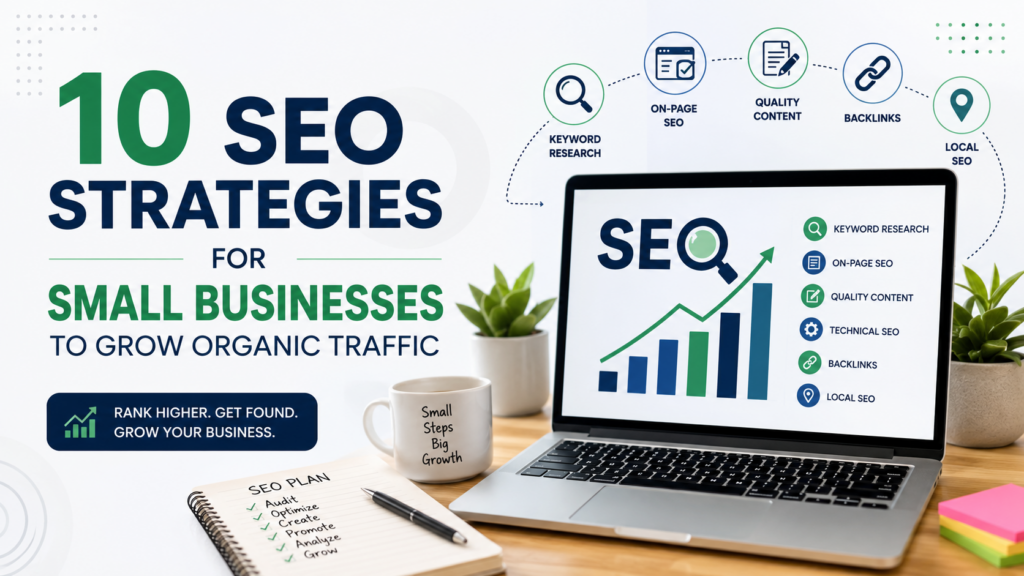
Running a small business today means competing for attention in search results dominated by bigger brands with bigger budgets. The good news? Search engines reward relevance and trust, not just ad spend. With the right SEO strategies for small businesses, you can outrank larger competitors in your local market and attract customers who are already looking for what you sell.
This guide walks through ten practical, budget-friendly tactics that work in 2026 — from local search optimization to content marketing and technical fixes. Whether you run a boutique, a service business, or an online store, these steps will help you build a search presence that keeps paying off.
1. Claim and Optimize Your Google Business Profile
For any local business, this is the single highest-leverage move you can make. A complete Google Business Profile helps you show up in the local map pack, which is often the first thing customers see when they search for products or services near them.
Make sure your business name, address, and phone number (NAP) are accurate and consistent everywhere online. Add high-quality photos, choose the correct business category, and write a clear description that includes relevant local SEO keywords. Encourage happy customers to leave reviews, and respond to every one — good or bad. Profiles updated regularly with posts, offers, and photos tend to rank higher than ones left untouched for months.
2. Do Keyword Research Before You Write Anything
Guessing what your customers search for is a costly habit. Instead, use tools like Google Keyword Planner, Ubersuggest, or Ahrefs to find search terms with decent volume and low-to-medium competition.
Focus on long-tail keywords — phrases with three or more words — since they’re easier to rank for and often signal stronger buying intent. For example, “affordable web design for small business” will convert better than a broad term like “web design.” Group related keywords into topic clusters so each page on your site targets a distinct, well-defined intent rather than competing with itself.
3. Optimize On-Page Elements Strategically
On-page SEO is where small businesses often leave easy wins on the table. Every page should have:
- A unique, descriptive title tag under 60 characters, with the focus keyword placed near the beginning
- A compelling meta description under 160 characters that encourages clicks
- One clear H1 heading, followed by a logical structure of H2 and H3 subheadings
- A clean, keyword-rich URL slug
- Naturally placed secondary keywords and LSI terms throughout the body, not stuffed in
Search engines have gotten better at understanding context, so writing for humans first and search engines second tends to produce better long-term results than mechanical keyword repetition.
4. Build a Content Strategy Around Customer Questions
Instead of publishing random blog posts, build content around the actual questions your customers ask before they buy. This is often called a hub-and-spoke model: one comprehensive “pillar” page covers a broad topic, while several shorter “spoke” articles dig into specific subtopics and link back to the pillar.
This structure signals topical authority to search engines and keeps visitors moving through your site longer. Add an FAQ section to key pages using real questions from customer emails, reviews, or sales calls — these often match how people phrase voice and conversational searches.
5. Prioritize Mobile-Friendliness and Page Speed
More than half of all search traffic now comes from mobile devices, and Google primarily uses the mobile version of your site for ranking. A slow, cluttered, or hard-to-navigate mobile experience will quietly push potential customers away before they even see your offer.
Run your site through PageSpeed Insights to spot issues like oversized images, unused code, or slow server response times. Compress images, enable browser caching, and consider a lightweight theme if you’re on WordPress. Even small speed improvements can meaningfully reduce bounce rates.
6. Earn Backlinks From Relevant, Local Sources
Backlinks remain one of the strongest ranking signals, but small businesses don’t need hundreds of links — they need the right ones. Look for opportunities close to home:
- Local business directories and chambers of commerce
- Partnerships with complementary businesses for guest posts or mentions
- Sponsorships of local events, sports teams, or community causes
- Press coverage from local news sites covering small business stories
A handful of relevant, high-quality backlinks from sites your actual customers trust will outperform dozens of generic, low-quality ones.
7. Fix Technical SEO Issues Before They Compound
Technical problems are invisible to visitors but very visible to search engines. Common issues worth auditing include broken links, duplicate content, missing alt text on images, and unoptimized XML sitemaps.
Tools like Screaming Frog or the free Ahrefs Webmaster Tools can crawl your site and flag these problems. Fixing broken links and redirect chains alone can meaningfully improve crawl efficiency, especially for sites that have grown organically over several years without regular maintenance.
8. Use Schema Markup to Stand Out in Search Results
Schema markup (structured data) helps search engines understand exactly what your content represents — a product, a review, an FAQ, a local business, an event. Pages with proper schema often display as rich results, such as star ratings, price ranges, or FAQ dropdowns directly in search listings.
These rich results take up more visual space and tend to attract more clicks than plain blue links. For local businesses, LocalBusiness schema combined with review schema is especially valuable since it reinforces the trust signals customers look for.
9. Build Topical Authority With Consistent Publishing
Search engines increasingly favor sites that demonstrate depth of expertise in a specific niche over sites that publish scattered, unrelated content. Pick your core service areas and commit to covering them thoroughly over time.
This doesn’t mean publishing every day. A consistent cadence — even one well-researched article every two weeks — that steadily builds out a topic cluster will outperform sporadic bursts of content. Update older posts periodically with fresh statistics, examples, and internal links rather than letting them go stale.
10. Track Performance and Adjust Based on Real Data
SEO isn’t a one-time project — it’s an ongoing feedback loop. Set up Google Search Console and GA4 to monitor which keywords bring traffic, which pages have high impressions but low click-through rates, and where visitors drop off.
A flat or declining click-through rate on a page that ranks well often points to a weak meta title or description rather than a ranking problem. Small, targeted adjustments based on this data — tweaking a headline, adding an FAQ, improving page speed — usually deliver better returns than starting over with a completely new strategy.
Frequently Asked Questions
1. How long does SEO take to show results for a small business?
Most small businesses start seeing measurable movement in three to six months, with more significant gains after six to twelve months of consistent effort. Local SEO tactics like Google Business Profile optimization often show faster results than competitive organic rankings.
2. Do small businesses need to hire an SEO agency?
Not necessarily. Many small business owners successfully manage foundational SEO themselves using free tools like Google Search Console and Google Business Profile. An agency or consultant becomes more valuable when competing in crowded niches or scaling content production.
3. What’s the most important SEO strategy for a local business?
Google Business Profile optimization typically delivers the fastest, most direct return for businesses that serve customers in a specific geographic area, since it directly affects visibility in local map pack results.
Final Thoughts
None of these SEO strategies require a massive budget — they require consistency and a willingness to prioritize your customer’s actual needs over shortcuts. Start with the highest-impact items: your Google Business Profile, solid on-page fundamentals, and a content plan built around real customer questions. From there, layer in technical fixes, backlinks, and schema markup as your site matures.
Small businesses that treat SEO as an ongoing habit rather than a one-time task consistently outperform competitors who set it and forget it. The compounding nature of organic search means the work you put in today keeps paying dividends for months and years to come.
Ready to Turn These Strategies Into Real Results?
SEO strategies work best when they’re tailored to your business, your city, and your customers — not copied from a generic checklist. At AdsnSEO, we help small businesses across Ecommerce, Real Estate, Health & Fitness, Food, Startups, and Fashion & Jewellery build search visibility that actually drives leads and sales.
Get a free SEO audit of your website and Google Business Profile today, and see exactly where you’re losing traffic — and how to fix it.